You have done Barcelona, Seville and Granada. Now stop booking villages you photograph and leave.
The usual approach is to treat rural Spain as a series of day trips from a city base – drive out, shoot the plaza, drive back before dark. That is the mistake. The villages worth your time are the ones that still have a bed and a kitchen after the coaches leave, and you only find out which those are by staying.
The nine below form a loop of roughly 1,150 miles. The practical version is 12 days in May-June or September, driving a small manual hired in Barcelona or Madrid at $40-55 a day. Several old-town gates are under 6.5 feet wide, so skip the SUV. Fuel and tolls for the full loop run about $220, and the AP-7 and AP-68 stretches are tolled, so carry a card that works abroad.
What you actually do: walk a cliff edge above a wine terraces, eat lunch in a street carved under a rock, cross an eleven-arch Romanesque bridge, climb pink walls at sunset, sleep behind a walled gate, drive a road lined with 388 painted faces, stand above a reservoir where frescoes once hung, and watch a water mill still turning.
This is a menu, not a checklist. Pick two or three villages, give each at least one night, and leave the rest for the next trip – the rooms in the smallest places run out long before the flights do.
Quick Tips Before You Start
Hire the smallest car
Several old-town gates are under 6.5 feet wide; a compact manual gets through, an SUV does not.
Carry cash and a toll card
Castle entries are $2-6 and often cash-only; the AP-7 and AP-68 take cards but not all foreign debit cards.
Lunch is the main meal
Village kitchens close between 4 and 8 pm, so eat the $14-18 menú del día at 2 pm and plan a cold dinner.
Book September in June
Rooms in Calatañazor, Frías and Maderuelo disappear three weeks ahead in September; book before you book flights.
Learn two phrases
English menus are rare. 'Menú del día' and '¿a qué hora abren?' cover most situations.
1. Siurana: A Cliff-Edge Village Above Priorat
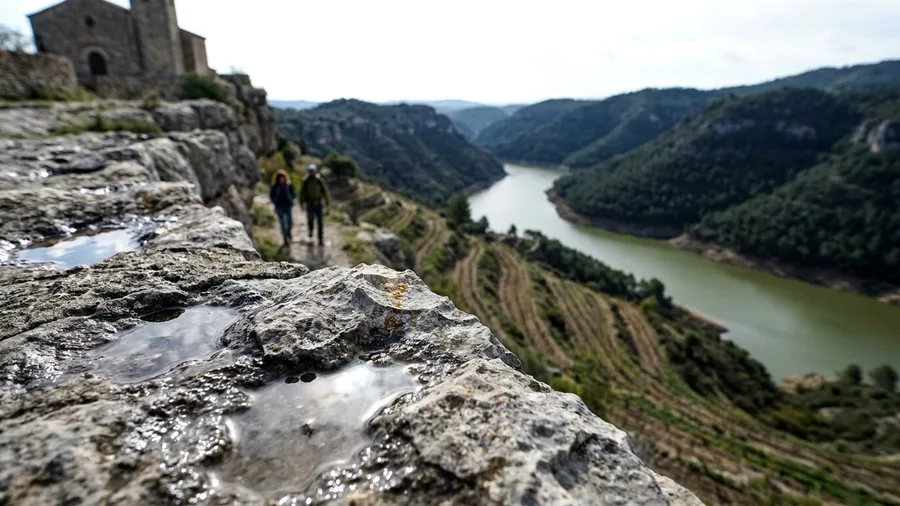
Compare it with any cliff town that charges you to stand on a wall, and Siurana comes out ahead: the best view here costs nothing and the climb up is free of queues. What it asks instead is your patience. Twelve hairpins lift the road off the Priorat valley floor and set it down on a limestone shelf where roughly thirty people live, the terraced vineyards for the region's reds beginning at the base of the crag rather than in some tidy park. This was the last piece of Catalonia held under Moorish rule, and standing on that shelf you can see why nobody took it easily.
Walk past the church of Santa Maria and the paved ground simply stops. A track runs twenty minutes to the edge, no booth, no ticket, where the rock drops away and Siurana's reservoir sits far below in a sheet of green-brown water. The village itself is small enough to see in a quarter of an hour; the cliff is the reason you came, so give the visit two to three hours and no more unless you climb, in which case the escarpment will keep you busy for days. Reus is an hour and a quarter behind you, Barcelona two hours.
The road up deserves respect. Climbers from all over treat this rock as a training ground, so expect traffic at the narrowest points and drive the hairpins in full light rather than at dusk. At six the truth shows: with thirty residents, the single restaurant is the whole evening. Reserve a table when you pass at lunchtime or you will be steering back down twelve bends in darkness toward Cornudella de Montsant, six miles below, where there is another bed.
💡 Tip: Park at the entrance lot and walk in; the lanes inside are too narrow to turn around.
| Village | Region | Best for | Closest airport (drive) | Time to allow |
|---|---|---|---|---|
| Siurana | Catalonia | Cliff edge and Priorat views | Reus (1 hr 15) | 2-3 hours or 1 night |
| Setenil de las Bodegas | Andalusia | Streets under the rock | Málaga (1 hr 45) | Half a day, lunch |
| Frías | Castile and León | Castle and Romanesque bridge | Bilbao (1 hr 15) | Half a day or 1 night |
| Albarracín | Aragon | Pink walls and empty hills | Valencia (2 hr 30) | 1 night |
| Calatañazor | Castile and León | One street, juniper woods | Burgos (1 hr 40) | 2 hours, lunch only |
| Fornalutx | Mallorca | Stone lanes and the Tramuntana | Palma (45 min) | 1-2 nights |
| Mogarraz | Castile and León | Painted faces and cherry blossom | Salamanca (1 hr 15) | Half a day or 1 night |
| Maderuelo | Castile and León | Walls, reservoir, emptiness | Madrid (1 hr 40) | 1 night |
| Taramundí | Asturias | Knives, water mills, Atlantic rain | Oviedo (1 hr 30) | 1-2 nights |
2. Setenil de las Bodegas: Streets Beneath the Rock
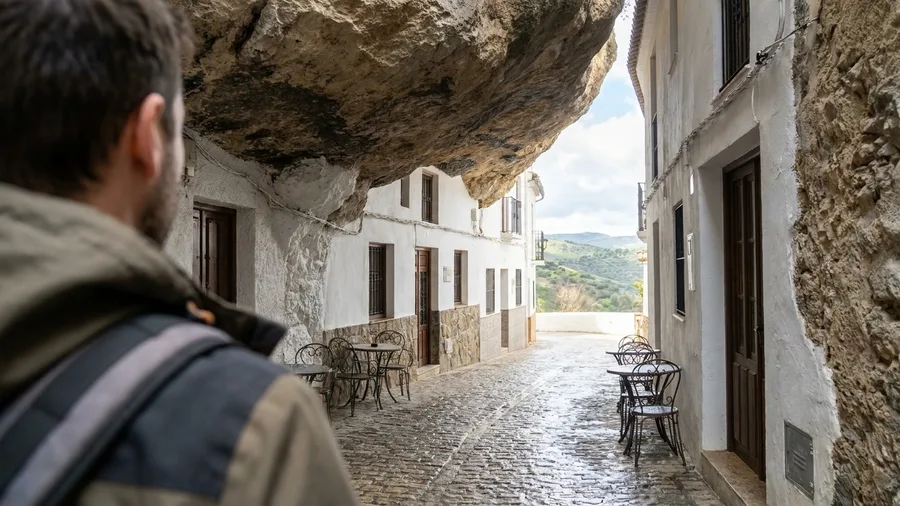
At Setenil the answer is the second, and that still surprises people. Streets like Cuevas del Sol and Cuevas de la Sombra are lived-in lanes where the bars and homes are set back into the gorge wall, not a set built to sell tickets. Around 2,700 people live here. The houses fill the overhang of the Rio Trejo, and the lanes are quite literally the gap left between the stone above and the ground below.
Five to ten dollars for a mollete and a coffee in a cave bar is the whole splurge, and worth it. Park outside the old centre for $0-3 since the covered lanes are too tight for a car, and arrive before 11am, ahead of the coaches rolling through from Ronda twenty minutes away. April-May or October beats August. The menú del dia, $14-18, is lunch, so eat before the kitchen shuts mid-afternoon, then drive the hour forty back to Malaga or plan to sleep in Ronda.
⚠️ COMMON MISTAKE
Don't book a room before you check the kitchen
Six of these nine villages have one restaurant or none. Call the casa rural and ask what time the kitchen closes before you pay a deposit – a bed without dinner means a 40-minute drive in the dark.
3. Frías: Hanging Houses Above the Ebro
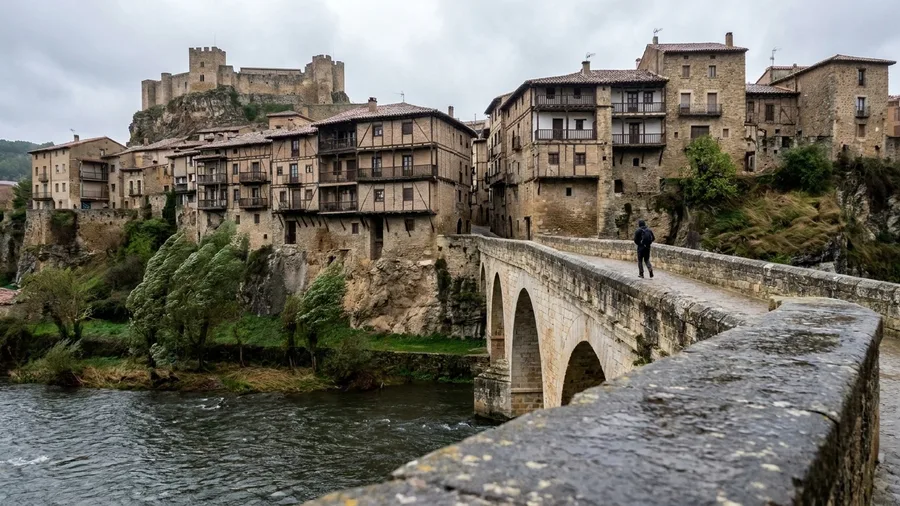
Know before you climb the road in that this is a small place, and the castle you have seen in photographs is only part of it. Frías holds around 250 residents and carries a town charter older than most of the towns that look down on it, one of the smallest places in Spain that can claim that right. The hanging houses lean out over the Ebro, and an eleven-arch Romanesque bridge carries you in across the water. Come in wanting half a day and it will fill.
💡 Tip: Stop at the Tobera waterfalls on the approach road – they are a ten-minute walk from the parking and worth the pause.
The 6pm test: stay, eat, or drive on
- Frías — Two casas rurales and one hotel; book three weeks ahead.
- Albarracín — Beds inside the walls; lanes empty after six.
- Fornalutx — Few beds, but the square belongs to guests after six.
- Taramundí — Museums run in the rain; kitchens open late.
- Siurana — One restaurant and one hostal – book both.
- Setenil de las Bodegas — Kitchen shuts mid-afternoon; sleep in Ronda.
- Mogarraz — Beds yes, dinner no – eat the menú at lunch.
- Maderuelo — One kitchen in town; book the table with the room.
- Calatañazor — No hotel and one bar – sleep in Soria.
4. Albarracín: Pink Plaster and Empty Hillsides
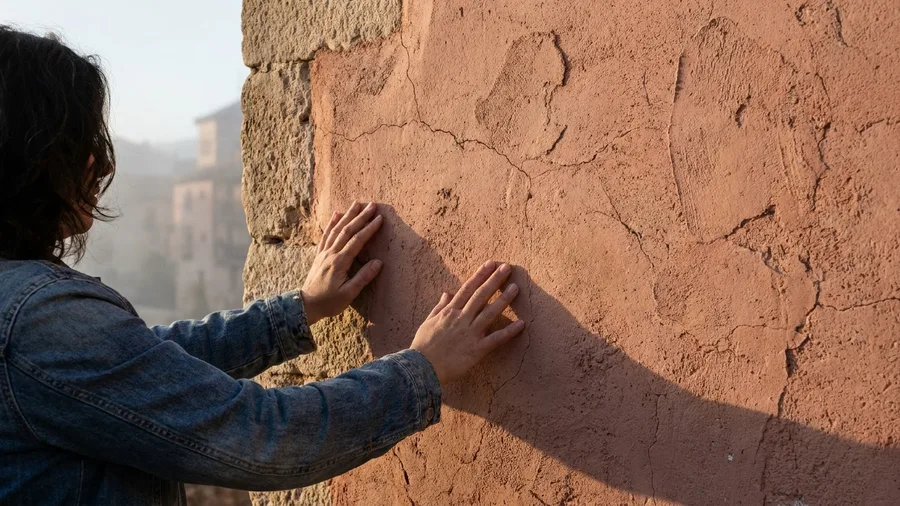
At six in the evening the light goes a soft, dusty rose and the whole hill seems to exhale. The color of Albarracin comes from iron-oxide plaster, and it burns brightest on the north-facing walls as the sun drops, so ask yourself which shot you actually want: the one at noon that everyone posts and regrets, or the one at dusk that nobody does.
This is a town of roughly a thousand people stacked on a rock spur, with pine and stone and almost nothing else for miles. Walk the walls and climb the Torre del Andador for about $5, allow one to two hours, and then stop trying to see anything more. The drive from Teruel is a short 90 minutes up through pine and tunnels that turns slow after dark; from Valencia it is closer to two and a half hours. But the point of Albarracin is the evening, when the day-trippers have gone, the lanes empty out completely, and the 6pm test passes on its own – the first place on this sweep where the answer is simply to sit down and do nothing for an hour. Stay one night inside the old town walls. You will not regret it.
Day-trip it or sleep there?
Worth a night
- Albarracín – lanes empty after six
- Fornalutx – square belongs to guests
- Frías – castle and bridge in the morning
- Taramundí – wet afternoons in the mill
Day trip only
- Calatañazor – no hotel, sleep in Soria
- Setenil – beds in Ronda, 20 minutes away
- Mogarraz – one bar closes early
- Maderuelo – one kitchen, book ahead
5. Calatañazor: One Street Behind the Walls
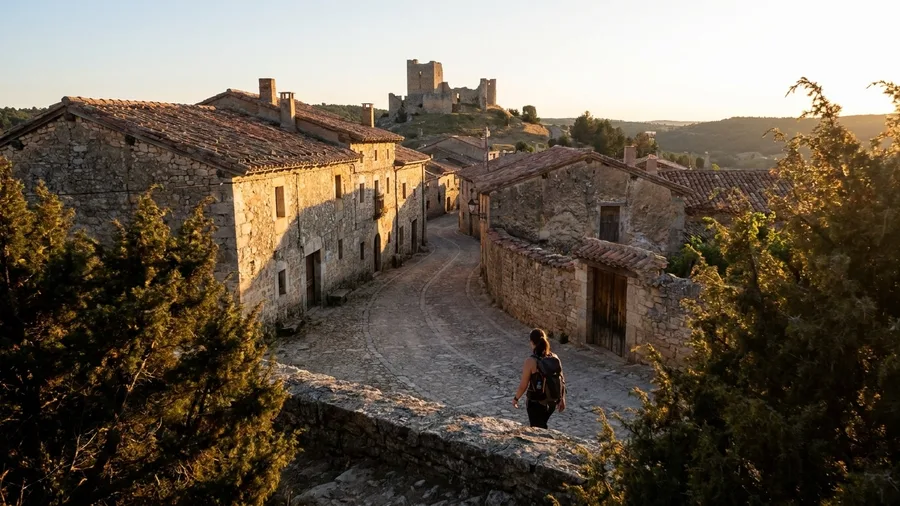
Calatañazor is worth the detour, but not the night. If a single picturesque main street is what you are chasing, these tiny towns with unreal main streets will help you plan the detour. Come for lunch, walk the single curving street from the gate to the ruined castle in about 45 minutes, and be gone before the light asks you to stay.
The village has around 50 residents, juniper woods pressing in on all sides, and almost no traffic. The museum costs about $2 and opens only at weekends. A 1002 battle with Almanzor is placed here – the story is the reason the castle exists, not a reason to linger. The real draw is the Sabinar de Calatañazor, the ancient juniper forest just outside the walls: pair the two, and the day fills itself. From Burgos it is 1 hr 40; from Soria, 40 minutes.
there is no hotel. One bar serves a menú for around $15, and that is the entire kitchen. Sleep in Soria, drive out for the middle of the day, and treat Calatañazor as a lunch stop rather than a base. The 6pm test fails here – and if a village of 50 people had a spare room, it would not stay a village of 50 for long.
How to book the small villages
September books out three weeks ahead in Frías, Calatañazor and Maderuelo.
6. Fornalutx: Stone Lanes in the Tramuntana
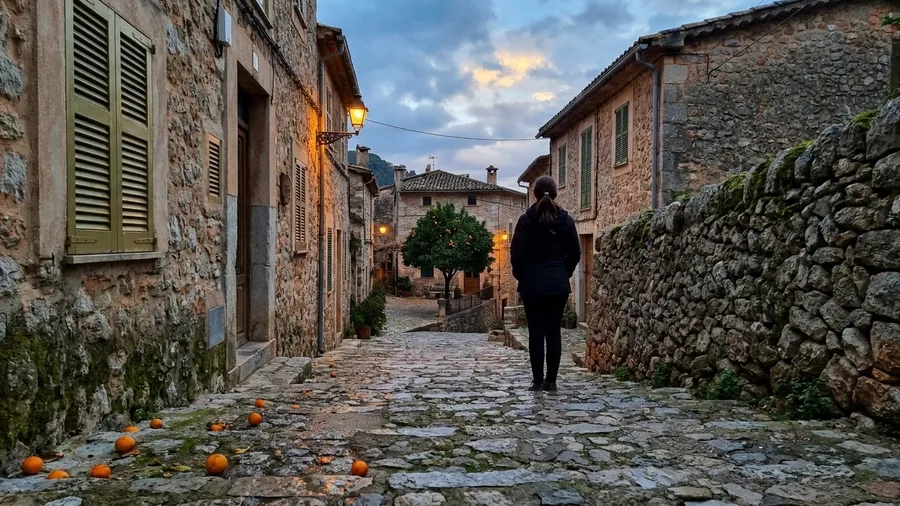
Forty-five minutes from Palma airport, twenty from Sóller, and four dollars to leave the car in the lot at the entrance – that is the whole toll for Fornalutx, and it buys you a village that has spent four decades refusing to become anything else. Since the 1980s, strict building rules have meant no hotel signs, no new facades, no coach bays. The stepped alleys and the orange-tree square are the same as they were.
Which is exactly why the beds are few, and why after six the square belongs to residents and guests rather than the crowd that came up from the coast for the afternoon. Come in May or October; if you insist on July or August, arrive before ten in the morning or do not come at all. Walk the Cami de s'Alzina down to Sóller in about an hour and a half one way, and take the vintage tram back if the timing works. Book the house for the night – Fornalutx is the counter-case to every village that kept its rules and lost its pulse.
💡 Tip: The tram from Sóller back to Palma is a separate line from the village walk – check the last return before you set out.
💡 PRO TIP
The 6pm test, stated plainly
Before you commit to any village on this list, ask one question: after the day visitors drive off, is there a bed and a kitchen still serving? If the answer is no, sleep in the nearest town and come for lunch instead.
7. Mogarraz: 388 Painted Faces on the Walls
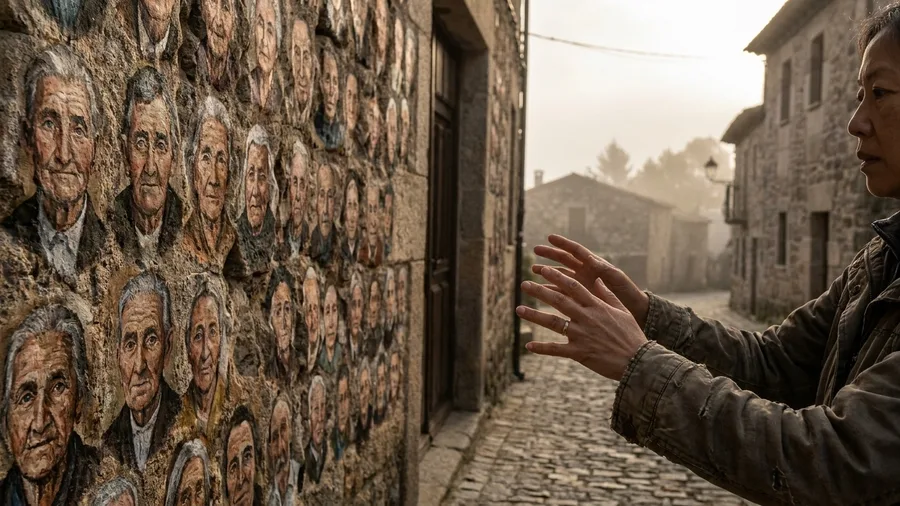
Mogarraz is a village of 250 people with 388 faces painted on its walls. Florencio Maíllo made them in 2012, working from old village photographs, one portrait to a facade, so the lanes are lined with the great-grandparents of the people still living in them.
It is a strange, clever answer to the question of what a facade is for. Elsewhere stone is protected by rule; here it was repainted from memory. Walk up through the steep streets and the dead look down at you from every wall, which takes about an hour if you go slowly. Cherry blossom in late March and the June cherry harvest are the two weeks the village fills; in other months you may be the only person in the lane.
It is 1 hr 15 from Salamanca, and 10 minutes from La Alberca, where the hotels are. Sleep in one of the two small hotels or a casa rural for $70-110 a double, eat the menú del día at lunch, and be back inside before the single bar shuts early. Beds yes, dinner no: this village passes half the 6pm test, so buy a bottle of the local cherry liqueur while the shop is open.
Mogarraz at a Glance
🚪 Old-town gate
Under 6.5 ft – hatchback only
🅿️ Parking
$0-5 a day, outside the walls
🍽️ Lunch only
Kitchens shut 4-8 pm, bar shuts early
💵 Cash
Museum and castle entries $2-6, Thurs-Sun
🌙 Sleep here
Two nights is the max this village repays
Skip if
You want dinner after 8 pm or an automatic car – the lanes are too narrow and the kitchens are closed.
8. Maderuelo: A Wall, a Reservoir, Missing Frescoes
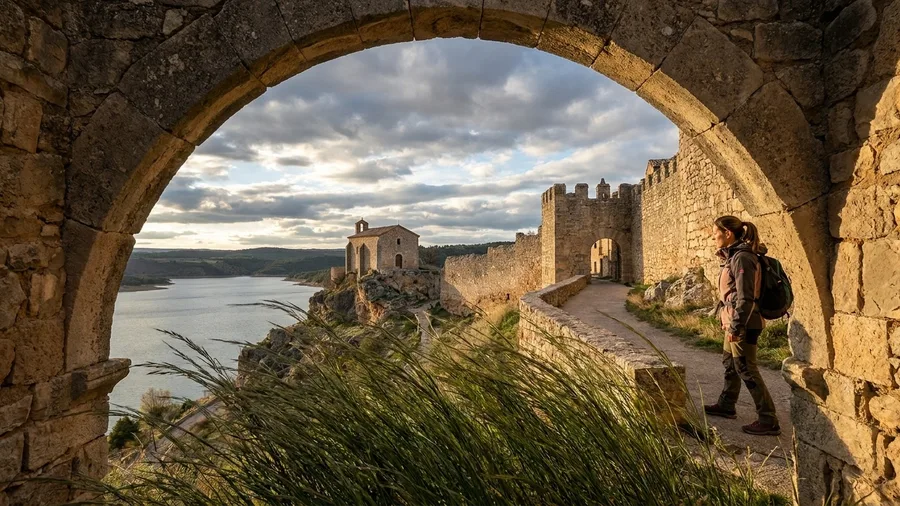
You pass through the gate and the noise stops behind you, and what registers first is not a sight but a silence so complete your footsteps on the cobbles sound like an event. Ninety people live here.
The famous thing is gone. The early twelfth-century wall paintings of the Vera Cruz hermitage – the Annunciation, the Three Marys at the tomb, that row of figures on a deep blue ground – were cut from the apse in 1929, packed onto panels and sent to Madrid, where you can see them for the price of a Prado ticket. The hermitage still stands above the water, stripped to bare stone, open to the wind. Knowing this before you arrive is what makes the visit work; expecting a painted chapel is what makes it feel like a detour with nothing at the end.
What is left fills two hours, and the emptiness is the exhibit. The walls, the gate and the walk along the reservoir will not compete with Albarracín's ramparts or Setenil's overhang – and they are not trying to. This is a village that keeps its record elsewhere, in a Madrid gallery, and lets the absence be the reason you came.
It's 1 hr 40 from Madrid and about an hour from Segovia, and the drive down from Ayllón through the Duratón canyon country is half the reason to come – the road folds between limestone walls the colour of dust, and you will pull over before you reach the village.
One restaurant, a handful of casas rurales, and no filling station in town. So the evening works like this: you book the table at the same time you book the room, and you fill the tank the day before, because at 6pm there is exactly one kitchen in Maderuelo that is open and a low fuel light here is a long, dark problem.
💡 Tip: The Prado's Villanueva building holds the frescoes in Madrid – see them there if the art is what draws you.
9. Taramundí: Knives, Water Mills, Atlantic Rain
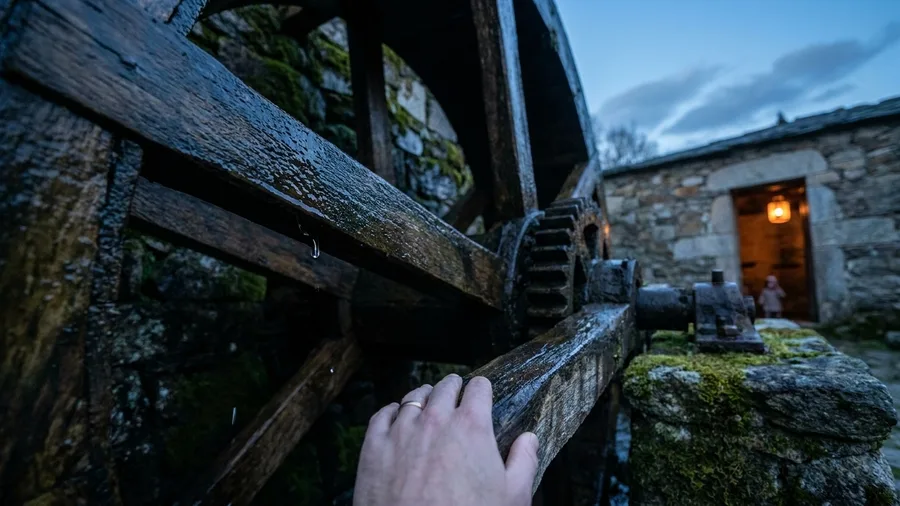
Bring a shell layer and expect rain, because in western Asturias it is not an interruption, it is the weather – the kind that arrives sideways off the Atlantic and settles in for the afternoon. About 600 people live in Taramundí, roughly an hour and a half from Oviedo and an hour and three-quarters from Asturias airport.
The village made its name in cutlery, and you can eat a plate of fabada – fat white beans, chorizo, morcilla, a slab of pork – for $14-18 in a menú del día while the rain hammers the window, then walk it off in the knife museum for about $4, where the displays run from Roman blades to modern pocketknives and a workshop will sharpen or grind a blade while you wait. Two miles away, Os Teixois is a working water-powered mill, forge and fulling mill, about $4 to enter, afternoons only. Keep one wet day for the machines and one dry day for the valleys; at 6pm in the rain, the museums are the ones that actually turn.
Frequently Asked Questions
How many days do you need for these nine villages?
Twelve days in a car is the practical version, at two or three villages with a night each. The full loop is about 1,150 miles, and you can cut it to a week by picking three villages in one region – Catalonia and Aragon, or Castile and Leon.
Do you need to book accommodation in advance?
Yes for the small ones. Calatañazor has no hotel, Frías has two casas rurales and one small hotel, and Maderuelo has a handful of rooms. September books out about three weeks ahead; May is easier but the best rooms still go first.
Is a car necessary?
For most of these, yes. Siurana, Frías, Calatañazor and Maderuelo are not on useful bus routes. Hire a small manual in Barcelona or Madrid at $40-55 a day and carry a card that works on the tolled AP-7 and AP-68 stretches.
When is the best time to go?
May-June or September. July and August bring heat and day visitors, especially in Setenil and Fornalutx. Late March is worth it for the cherry blossom in Mogarraz, and Taramundí is wet year-round, so pack for rain whenever you go.
How much does a day in these villages cost?
A casa rural double runs $70-120 a night, a menú del día $14-18, and castle or museum entries $2-6 in cash. Fuel and tolls for the whole loop come to about $220, and parking outside the walls is $0-5 a day.
Do people speak English in these villages?
Rarely. Menus are in Spanish, and in Siurana and Fornalutx also in Catalan. Learn 'menú del día' and '¿a qué hora abren?' and you can manage everywhere on this list.
Two Nights, Four Villages, Seven Days
Nine is an inventory, not an itinerary. Two villages at two nights each is the shape of a 10- to 14-day trip, and no village here repays a third night.
Choose by airport and days: from Barcelona with 10 days, Siurana then Albarracin (2 hr out, 3 hr between); from Madrid with 10 days, Maderuelo then Calatanazor (1 hr 40 out, 1 hr 30 between); from Malaga with 10 days, Setenil then Albarracin (1 hr 45 out, one 5-hour transfer north); from Bilbao with 12 days, Frias then Taramundi (1 hr 15 out, 3 hr west, Asturias airport 1 hr 45).
The 11pm photo that survives the trip is the one with a lit kitchen at 1pm and a bed above it – Setenil's cave bar at lunch, Fornalutx's orange-tree square after six. First action, before any flight: hire the smallest car available ($40-55 a day, because several old-town gates are under 6.5 ft wide) and book two casas rurales ($70-120). Rooms in Calatanazor, Frias and Maderuelo run out long before the flights do.
Book the bed before the flight
Open your calendar, pick two villages from the table above, and call their casas rurales this week. The smallest rooms go first.