The number I keep coming back to is 18. That is what my bag weighed for ten days in Portugal last September, after 30 years of checking a 26-inch suitcase that ran 42 pounds, cost me $40 each way on its last trip, and went missing for two days in 2019.
Same ten days this time, late September, three cities, two flights, four trains, 62 to 78 degrees: one soft-sided bag at 22 by 14 by 9 inches, 40 liters, 7.6 pounds empty, packed to 18, plus a 12-inch daypack that slid under the seat.
The list is not a test of suffering. Every item earned its place on repeat wear, on how it washes, or on a job nothing else did, and a quarter of the bag stayed empty on the way out.
Pack the fourteen items once and you can do the day-five sink wash in Porto and still have clean clothes for the second half.
Quick Tips Before You Start
Check the airline size limit
Before every trip I open the airline's carry-on page, because the 22 x 14 x 9 inch standard is common but not universal.
Roll, don't fold
Rolling each merino top into a cylinder takes less space than folding and keeps wrinkles out.
Pack for repeat wear
Every clothing item should be worn at least twice between washes, or it does not go in.
Schedule the wash
Pick a day midway through the trip for the sink wash, not when you run out of clean socks.
Leave a quarter empty
The empty quarter at the top of the bag is not wasted space; it is what lets you bring something home.
1. The 22-Inch Soft-Sided Rollaboard
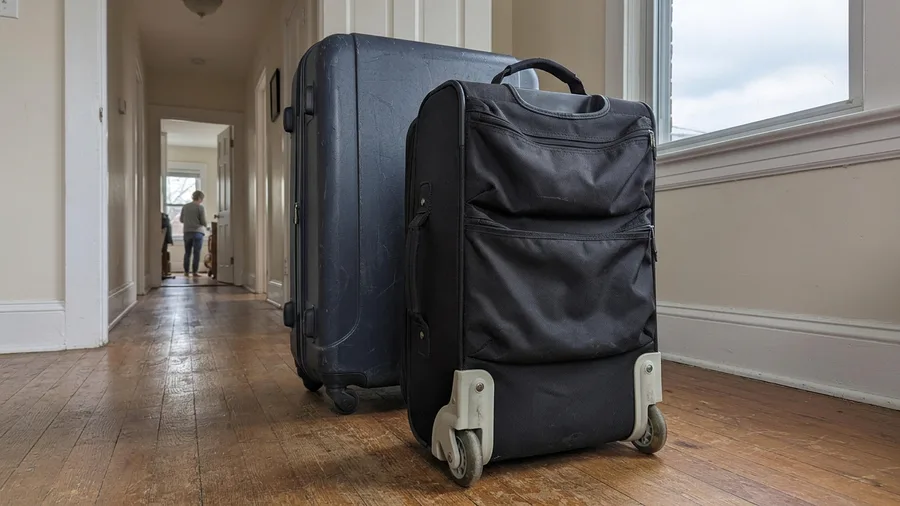
Forty dollars each way, and two days without my bag. That was the arithmetic that finally broke a thirty-year habit. The 26-inch checked suitcase weighed 42 lb dressed for a trip, and on its last outing the airline charged me $40 going and $40 coming back; in 2019 that same bag sat in a system somewhere for two days while I wore the same shirt to dinner in Lisbon. Two failures, one bag, and I stopped arguing with myself.
The replacement is a soft-sided rollaboard, 22 x 14 x 9 in, 40 L, 7.6 lb empty, $180. Packed for the ten days in Portugal it weighed 18 lb on the hotel scale. Soft sides are the point: the bag compresses into an overhead bin, absorbs a gate-check without cracking, and gives when the bin is already half full, where a hard shell just adds bulk and no flex. The 40 L meets typical cabin sizing, but I check the airline's published size and weight limits before every trip rather than assume. Left at home this time, all defaults from the 26-inch era: a second pair of jeans, the laptop, a hair dryer, a third pair of shoes, and a formal outfit packed just in case. Against $80 in round-trip fees and the risk of another missing bag, the $180 pays for itself on the second trip, and the 18 lb rides with me instead of under the plane.
💡 Tip: A $180 bag pays for itself on the second round-trip where you would have paid $80 in checked-bag fees.
⚠️ COMMON MISTAKE
The carry-on limit is not one number
A 22-inch bag fits most major airlines, but weight limits and sizer bins vary. I check the specific airline's carry-on page before every booking, not at the gate.
2. Three Packing Cubes, One Per Layer
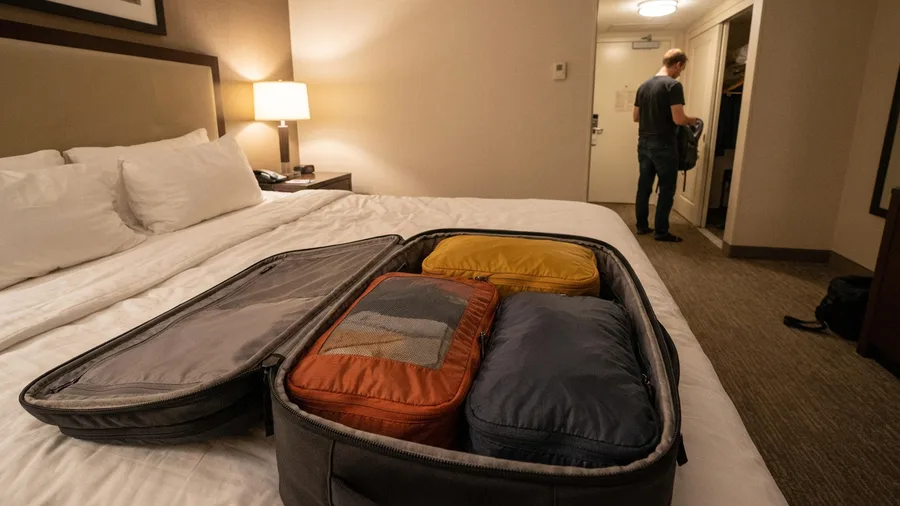
You unzip the top of a 40 L bag in a hotel room at 9 p.m. and see nothing but a dark mass of fabric. That is the moment packing cubes earn their $35, because you can feel the top layer give and know exactly what is under your hand without lifting anything out.
Three cubes turn the bag into three known compartments, one job each: clothes, the daypack swap, and laundry with the dirty items. Everything stays visible, and repacking takes about two minutes because nothing has to be re-sorted, only re-zipped. Get compression-style cubes, not vacuum bags, which need a pump and a one-way valve that can fail on the road.
The $35 set is the difference between an 18-lb bag you can repack in a hotel room and a 40 L sack you have to empty onto the bed to find a sock. The dirty cube also quarantines the day-five wash, so the clean clothes stay clean for the second half.
💡 Tip: The dirty cube isolates the day-five wash from the clean clothes, so the second half of the trip still has clean shirts.
| Item | What I use | Cost | Why it earns its space |
|---|---|---|---|
| Bag | Soft-sided 22 x 14 x 9 in, 40 L, 7.6 lb empty | $180 | Fits overhead, survives gate-check, 18 lb packed |
| Packing cubes | Set of three compression cubes | $35 | Three known compartments, repack in two minutes |
| Merino tops | Five tops, worn twice each | $70 each | Ten days of dinners and trains from five shirts |
| Pants | Two pairs: stretch travel and dark straight-leg | Already owned | Replace jeans plus a formal backup |
| Overshirt | One cotton-wool overshirt | Already owned | Covers 62°F mornings and cold trains |
| Underwear and socks | Five quick-dry underwear, four socks | Already owned | Five days clean, five after the sink wash |
| Shoes | One pair worn, one packable pair | Already owned | Two pairs fit at the wheel end with socks inside |
| Liquids | Six 3.4-oz bottles in a quart bag | Already owned | Decanted from bathroom products, not bought |
| Shampoo bar and laundry sheets | One $12 bar, $9 pack of sheets | $21 | Neither counts against the liquids bag |
| Daypack | 12-inch packable daypack | $60 | Personal item and daily walking bag |
| Charger kit | 65W charger, two cables, adapter | $25 | Charges phone, watch and e-reader from one outlet |
| Pouch | Flat zip pouch for meds and glasses | Already owned | Never leaves the daypack |
| Folder | Printed confirmations and passport copy | Already owned | Works when the phone dies |
| Empty quarter | About a quarter of the 40 L | Free | Room for what comes home |
3. Five Merino Tops and No Cotton
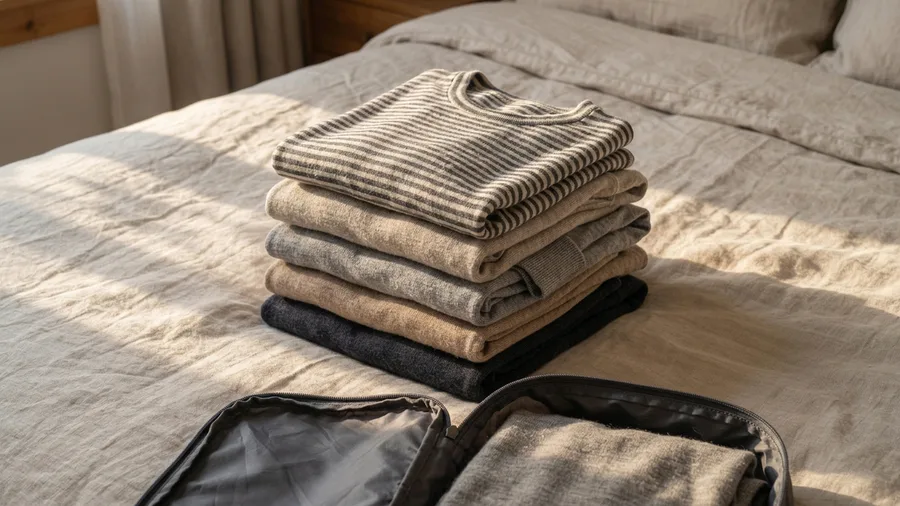
Five, and only because they're wool. With the clothes cube open in front of you, that's the whole decision: five merino tops at $70 each – two neutral, one dark, one striped, one long-sleeve – worn two days apiece before they hit the day-five wash. That's ten days of dinners, trains and walking covered by a stack no bigger than two folded cotton shirts.
The reason is the fiber, not the count. Wool can go a second day against skin without picking up the smell cotton does by lunchtime, so each top earns its slot twice. Cotton t-shirts stay home, every one of them, because they hold sweat and odor and would drag you to a sink every single night. At $350 for the five, I'm not pretending it's cheap – I'm saying the wool replaces a bigger, heavier stack of cotton and cuts the number of washes the trip requires.
At 18 lb packed, these five are the core of the weight budget. Test each one by what it replaces: this striped top stands in for two cotton shirts and a wash cycle; this long-sleeve stands in for the sweater I'd have packed for 62F mornings on the trains. Add the merino up and it's the fourth of the clothes cube that earns its space on repeat wear and washability, not on how it looks in a photo.
4. Two Pants That Dress Up or Down
The light on the Ribeira in late afternoon is low and yellow, the granite quay still warm under your hand at six, and the whole riverbank smells of grilled sardines and diesel off the tourist boats. That is where you sit, on the bottom step with your legs out, and do nothing for an hour.
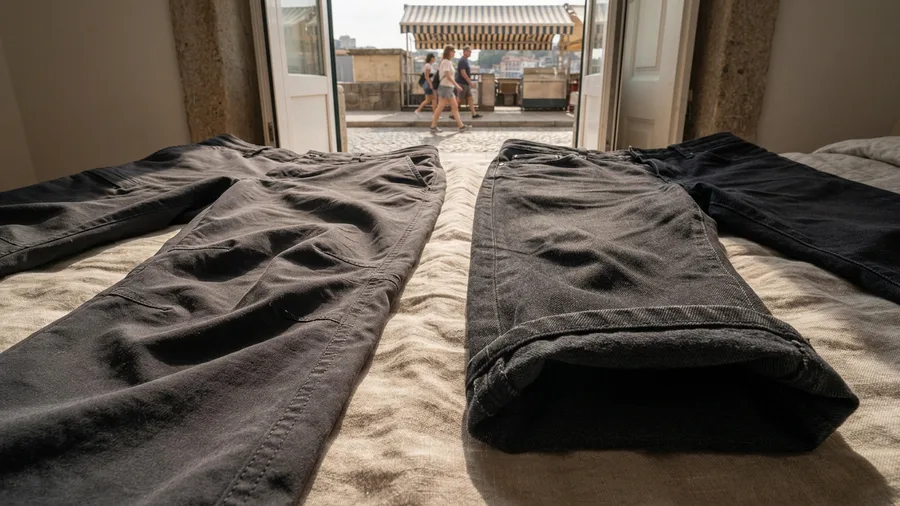
The stretch travel pant handles those cobblestones and the two-hour walk up to the cathedral without chafing, and the darker straight-leg pair covers the restaurant that turns out grander than you booked. Both shades are dark enough to swallow a spilled espresso. Weighed against the old 26-inch bag, two pairs of these come in lighter than the single pair of jeans I used to pack, and the ounces I got back went into the extra merino tops that let me stretch the wash cycle.
💡 Tip: The second pair of jeans stays home. Two pairs of these pants weigh less than one pair of jeans in the bag.
Before You Zip the Bag
- Check the airline carry-on page Size and weight limits vary by carrier and route.
- Decant the six liquids bottles From full-size products already in the bathroom.
- Schedule the day-five sink wash Put two laundry sheets in the dirty cube now.
- Print confirmations and passport copy First two nights of hotels at minimum.
- Charge the daypack devices Phone, watch and e-reader overnight before you leave.
- Weigh the packed bag Aim for 18 lb or less; a luggage scale is $10.
5. One Overshirt That Works as a Jacket
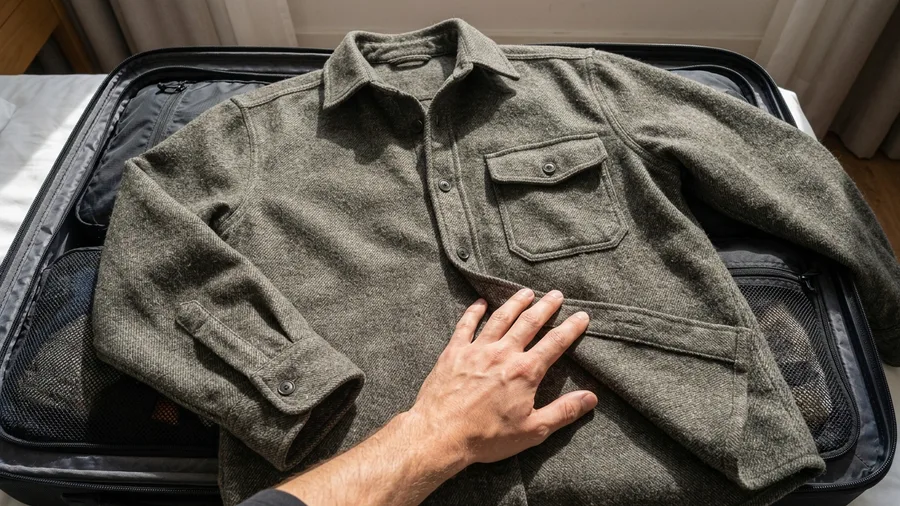
The overshirt cost me more room than the pants did – it is a cotton-wool mid-weight, folded, maybe an inch and a half of the bag – and it earns every inch. It is the one item I wear on travel days and pack the rest of the time, and it does what a sweater and a light jacket used to do across two slots. That is the trade: one thicker garment instead of two thin ones, and less air in the bag.
It covered the 62°F mornings in Lisbon, when the wind coming off the river made a summer shirt a mistake until about 10 a.m., and it covered the air-conditioned trains, which run cold enough that I had it over my knees on the Porto leg. On the 62-78°F trip it was the only extra layer I carried.
On the flights it folded into a pillow against the window and did not get packed at all. That is the third job, and the reason I stopped counting it as clothing and started counting it as gear – a garment that lies flat on a plane and hangs on a chair at dinner.
anyone traveling in the 60s and 70s who hates being cold on a train, and anyone who would rather own one good layer than a jacket that never leaves the bag.
if you are going somewhere genuinely cold, a mid-weight overshirt is not a coat, and you should take the coat and leave the third pair of shoes. If you run hot on planes, a compressible down vest does the same job at half the folded size, at more money.
One mid-weight item doing three jobs keeps the pack at 18 lb and leaves the top quarter free – which is what the bag was for.
💡 Tip: Wear the overshirt on travel days. It saves space in the bag and keeps you warm on the flight.
What stays home and what replaces it
The 26-inch era
- 26-inch checked bag, 42 lb packed
- $40 each way in checked-bag fees
- Bag missing for two days in 2019
- Second pair of jeans and a formal outfit
- Laptop, hair dryer and a third pair of shoes
The 22-inch list
- 22-inch soft-sided rollaboard, 18 lb packed
- $0 in fees on every flight
- Bag stays with me in the overhead bin
- Two pants that dress up or down
- Daypack, charger and paper copies only
6. Five Underwear, Four Socks, One Sink Wash
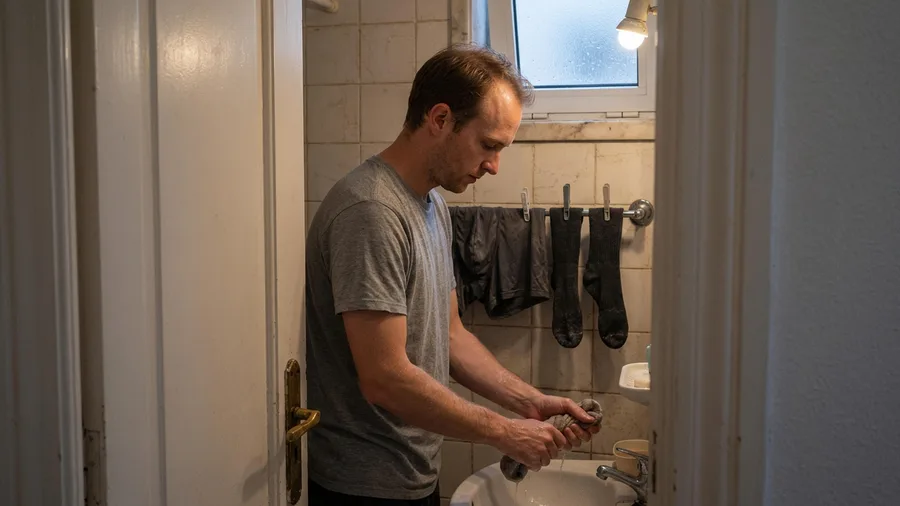
The thing to know before you commit to five and four: the wash day has to be scheduled, not improvised. Put it on the calendar before you leave or you will spend the second half rationing and hunting for a laundromat.
Quick-dry pairs, five underwear and four socks, give you five days of fresh wear, then the same again after the wash. On day five in Porto I stood at the hotel room sink for about twenty minutes with two of the $9 laundry sheets, worked each piece in warm water, wrung them hard and laid them along the towel rail. They were dry by morning; I pulled on the socks and there was no damp seam at the toe.
Five and four is enough because the wash is planned into the trip. It runs on an outer layer that keeps you warm at 62°F, then passes to the wash that resets the whole set.
7. One Pair Worn, One Pair Packed
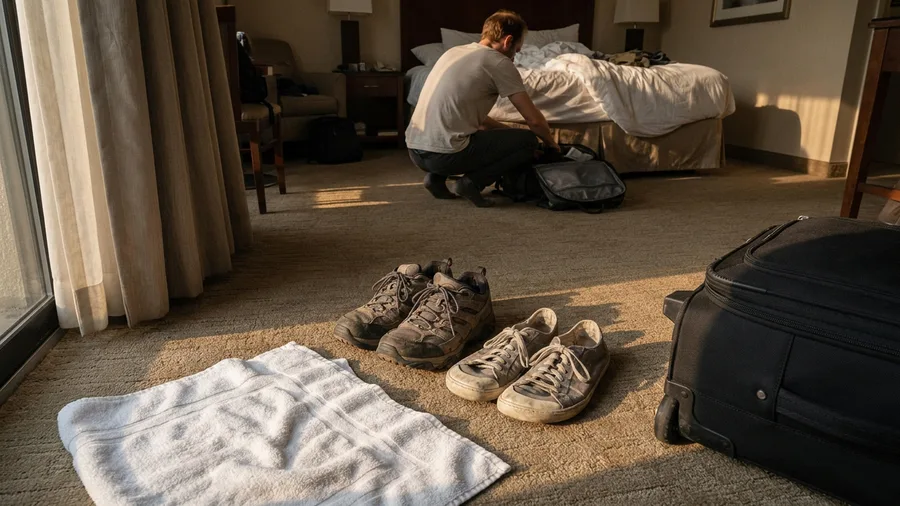
Two pairs of shoes is the whole allowance: one on your feet, one in the bag.
Once I planned a wash into the middle of the trip, footwear became the biggest thing left that could wreck the packing. My walking shoes fly on my feet on travel days, which keeps roughly two pounds off the scale and out of the 40 L bag. The pair that rides inside is a pair of packable flats or lightweight sneakers that flatten to under an inch and a half stacked sole to sole. That packed pair takes the cobblestones in the evenings and still looks presentable at a dinner that turns out nicer than the reservation suggested.
Shoes go in first, at the wheel end, because that is where the frame is and where a heavy lump hurts least. I stuff socks inside them, which sounds trivial until you watch a bag gain an extra day's worth of space. That hollow is dead air otherwise, and dead air is what a bag weighs when it will not close.
What stayed home was the third pair and the formal shoes kept for a wedding that never came. Those were the old habit, the ones pulled out of a 26-inch bag and never touched. If you are wavering about a third pair, pack it, carry the bag around the block, and see how you feel at the top of the stairs.
Here is the hour that matters, and it is not the one you would guess. Pack the shoes late at night after the rest is in, because that is when you finally see how much room the wheel end has, and it is always more than it looked at noon. Do it in the morning instead and you will squeeze too hard and leave a bulge that catches on the bin.
💡 Tip: Stuff socks inside the packed shoes to use the dead space and save room in the cube.
The liquids bag at a glance
🧴 Bottles
Six 3.4-oz
🥅 Bag size
One quart, clear
🧼 Shampoo bar
$12, no liquid
🧺 Laundry sheets
$9 for four
📋 What I check
TSA and airline pages before every trip
The rule
Decant from the bathroom, not from a travel-size aisle. You already own the products.
8. A Quart Bag With Six Bottles

Spend around $4 on six little 3.4-ounce bottles and you never buy another travel-size shampoo as long as you live. Shoes at the wheel end of the bag leave the whole top open, which is exactly where a one-quart clear bag needs to sit, because it has to come out at the security bin without you gutting the case in front of the queue. Mine is packed as: a pump bottle of the shampoo I actually use, the conditioner that goes with it, lotion, face cleanser, sunscreen, and one empty one filled from the big bottle at home. Nothing in that bag was bought in a travel aisle. I decant from the bathroom shelf the night before, label each lid with a strip of masking tape, and screw them tight enough that I check them again in the hotel.
The six bottles cost me about $4 total and refill forever, which is the cheapest thing in a kit that starts with a $180 bag. They do it with roughly a week and a half of product inside, because two small pumps of shampoo is a hair wash and you will not use six bottles' worth in ten days no matter how you try. Two practical notes. The liquids rule changes: I read the TSA page and my airline's own page before every trip rather than trusting what I remember from last time. And I fill each bottle about 90 percent, never to the brim, because pressure in a soft bag at altitude pushes a full bottle past its own cap.
💡 Tip: Label each bottle with a marker. In a quart bag at security, the unlabeled ones always look suspicious.
💡 PRO TIP
The bar and the sheets are not liquids
A shampoo bar in its tin and laundry sheets in a zip bag do not count against the quart. That frees two bottle slots for things you actually need.
9. Shampoo Bar, Laundry Sheets, No Spill Risk
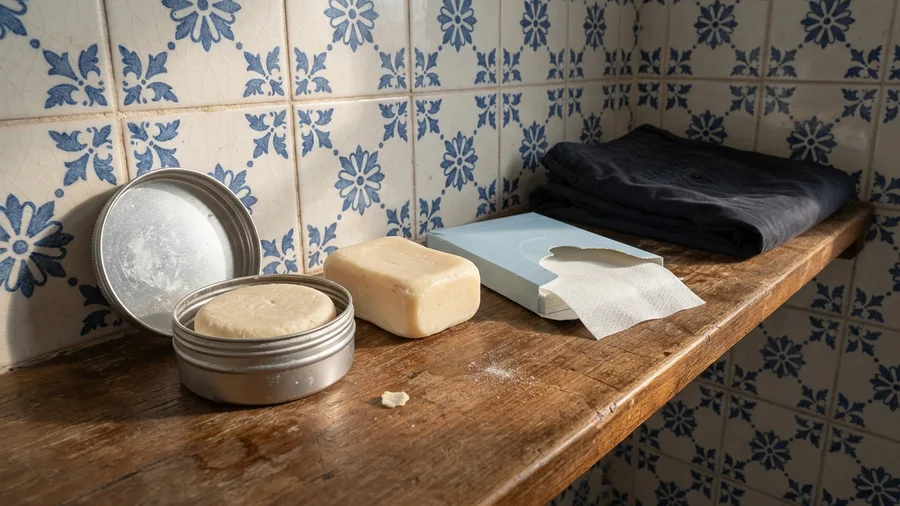
Corners get filled with fixed items: the two messiest jobs, washing hair and washing clothes, travel as solids.
A $12 shampoo bar replaces a whole bottle and rides in its own little tin, so it cannot leak into the merino. I bought a pack of laundry sheets for $9 and keep four in the bag; the day-five wash uses two, and the rest come home for the next trip. Neither one counts against the liquids bag at all, which frees two more slots for the things that only come as liquid. The photograph I keep from this part of the packing is small and quiet: the shampoo bar in its tin sitting beside a folded pair of pants on a hotel shelf in Porto, where a cracked bottle would have ruined both.
10. The 12-Inch Daypack That Slides Underfoot
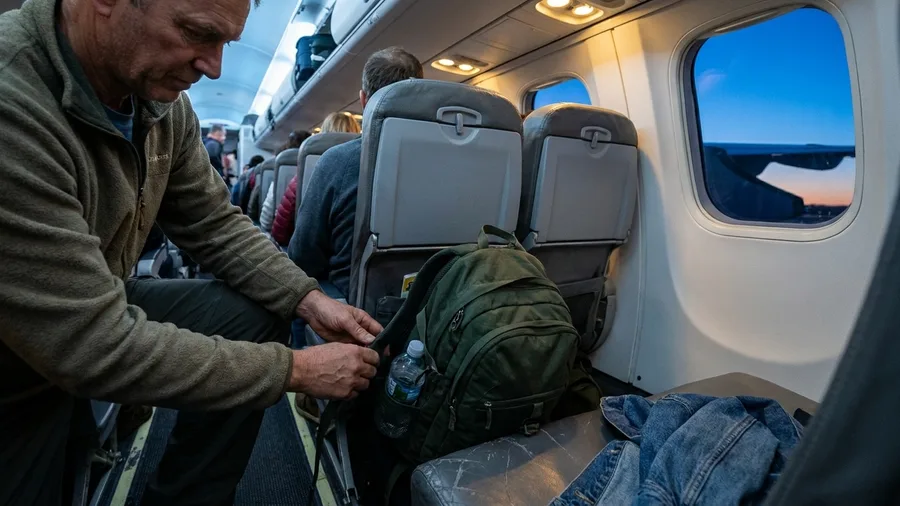
Buy the $60 daypack, but know the catch before you do: it is a 12-inch packable sack with almost no structure, so it carries a laptop, a passport and a layer, not the souvenir haul from the Porto market on day nine. If you want a proper walking bag with a padded back, this is not it.
Packed down, it is about the size of my fist, and on the small regional prop plane out of Lisbon it slid under the seat in front of me where a rigid bag would have been gate-checked without a second thought. On the flight it held my passport, the chargers, the medication pouch, a water bottle and one change of layer, which is everything I actually reached for between takeoff and landing.
In every city it became the walking bag, on the trains it was the bag at my feet, and it meant I packed no second day bag at all. That is the only test that matters here: one $60 item that is both the personal item and the daily carry, and the 40 L rollaboard still closes at 18 lb because the daypack never went in it. Mine is thin at the base and I would line it with a folded shirt for a heavier day, but I would buy it again.
11. One Charger, Two Cables, One Adapter
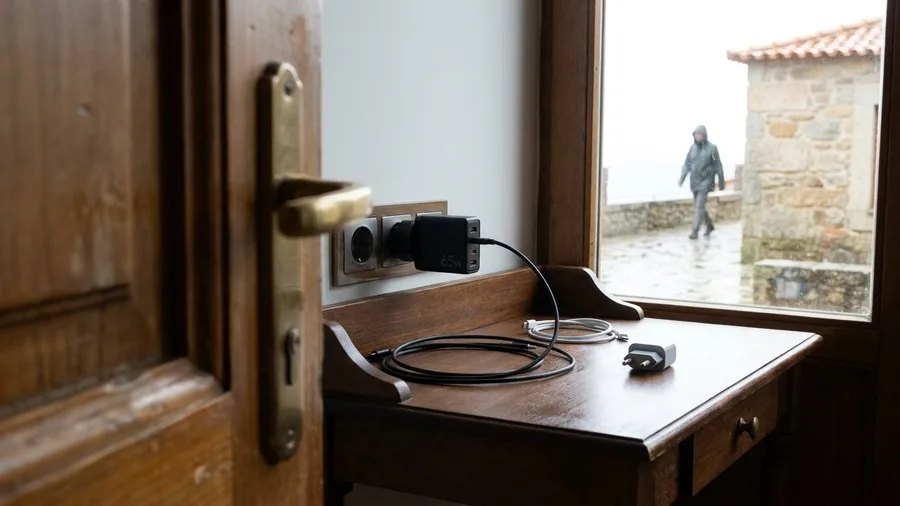
The one thing to know before you buy the 65W multi-port charger: it is the single point of failure for every device you own, so you do not leave home without testing it on the phone, the watch and the e-reader together the night before, and you do not buy the cheapest one on the site.
That charger plus two cables and one plug adapter ran about $25, and it charged all three devices overnight from one Portuguese wall outlet. The second charger and the folding power strip stayed home. On a trip where the daypack is mostly power and cables, cutting them to one charger and two cables is what kept the under-seat bag light enough to carry all day without noticing it.
Two cables, not four, because I bring a USB-C for the phone and one short cable for the watch and e-reader, and a plug adapter suited to the country rather than a universal brick. The charger lives in the daypack, never in the overhead bag, so at the seat I was not the person standing up to dig through the luggage bin while everyone else settled.
The odd bit is where it all goes: one small zip pouch, a rubber band around the two coiled cables, and the whole nest is the size of a paperback. It takes thirty seconds to set up at a hotel desk and thirty to pack away, and it does not tangle into the mess my old cable bag became by day three.
The honest reservation is weight and heat: a 65W charger is heavier than the 20W brick that came with the phone, and it runs warm when all three devices are pulling at once. For a phone-only traveler it is overkill. For anyone carrying a watch, a reader and a phone on a ten-day trip, it is the only charger I would pack.
💡 Tip: One 65W multi-port charger replaces the three single-device bricks you used to pack.
12. A Flat Pouch for Meds and Backup Glasses
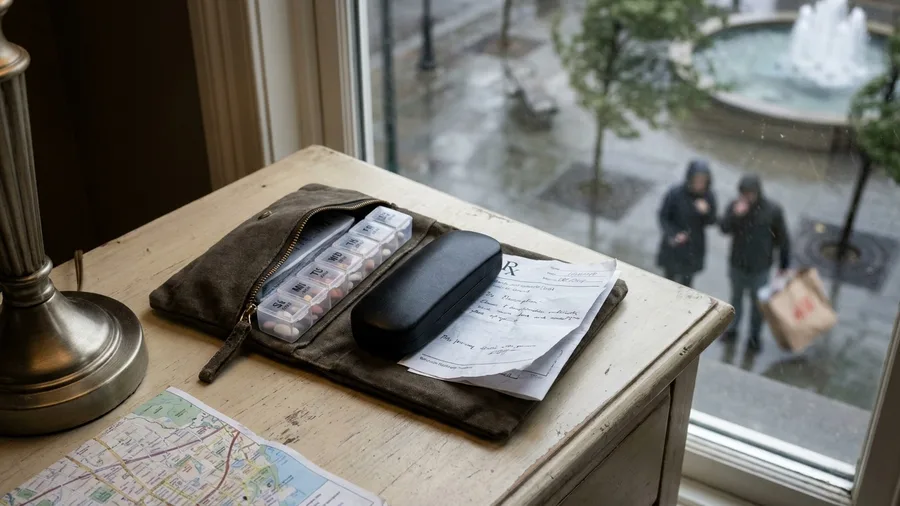
The pharmacy bag at a Lisbon counter smells faintly of paper and dust, and the woman behind it slides your prescription across the counter with a nod, and every printed expiry on the boxes is a date you have not yet planned around. That is the first moment you understand which items in your luggage cannot go anywhere near the hold, and it is a small list: the medication, the glasses that let you read the ticket, and the paper that proves both are yours in an emergency.
I keep one flat zip pouch for exactly those things, and it rides in the 12-inch daypack that sits under the seat the whole flight, never in the overhead bin. Seven days of prescriptions, plus two extra days in case the trip runs long or a train is cancelled, a spare pair of glasses in a hard case, and a photocopy of the written prescription all fit inside a pouch that flattens to nothing. The spare pair is the item most people leave behind and most regret: lose a lens on the cobbles in Porto and you spend a morning finding an optician instead of walking the river.
Before every trip I check the airline's page and the pharmacy's rules on carrying medication across a border rather than trusting what worked last time, because the rules do change. The pouch earns its place in the daypack for one reason: when a gate agent waves the rollaboard into the hold on a full regional flight, the medication stays with me, and so do the glasses.
13. Paper Copies in a Single Folder
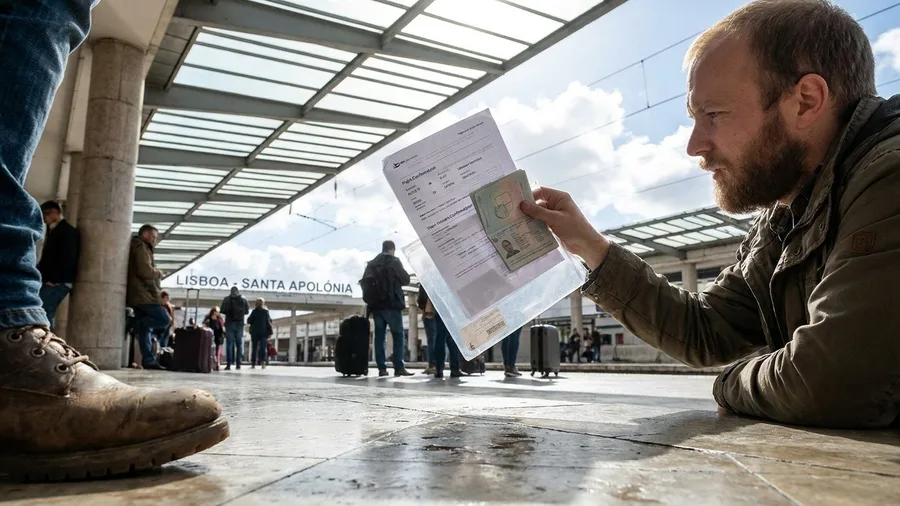
The folder costs about four dollars at any stationery shop and weighs less than the boarding pass inside it, which makes it the cheapest thing in a bag built around a $180 suitcase. Mine is a slim plastic wallet, the kind that holds a passport without bending it, and it has never once failed me at a desk. A phone dies at a border for the same reason it dies anywhere: you have been on a plane for nine hours, the battery is at four percent, and the arrival hall has no outlet. I keep printed copies of every flight, every train, and the first night's hotel confirmation, folded flat and in order of use, so I can hand over a piece of paper and keep moving.
The photocopy of my passport photo page lives in a different pocket from the passport itself, because the whole point of a copy is that it survives the loss of the original. One credit card and about sixty euros in cash sit in the folder too, not in the daypack, so a stolen or soaked bag still leaves me able to pay for a taxi to the embassy. I check the State Department page and my airline's document requirements before each trip rather than trusting what was true last year, since the rules move. None of this costs anything, and none of it is interesting until the screen goes black at a hotel desk in a city where you do not speak the language.
💡 Tip: Print the first two nights of hotel confirmations and back them up with a photo on your phone.
14. The Empty Quarter at the Top of the Bag
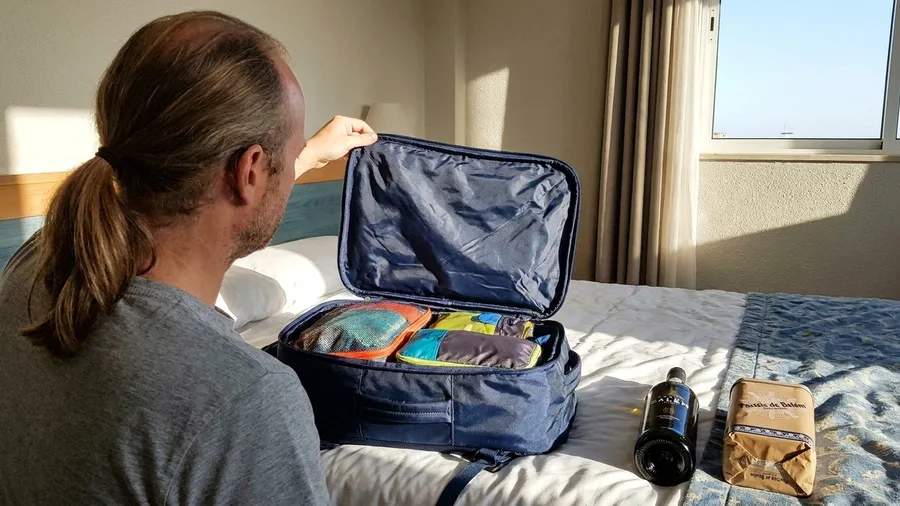
A quarter of a 40-liter bag is about ten liters, which on the way out is ten liters of nothing and on the way back is a pasteis de nata tin, two bottles of port, a linen shirt, and the ceramic bowl that would have gone in a checked bag and arrived in pieces. My packed weight on the outbound leg was 18 lb, comfortably under any typical cabin limit, and the top of the bag was left soft and empty on purpose. That is not slack packing. It is the reservation you make for the trip, and I have never once come home from Portugal with it unused.
If the bag will not close on the return, the second pair of pants comes out first, then the overshirt, both rolled tight into the daypack, which becomes the personal item at the gate. I have done this exactly once, in Lisbon, and the bag closed with the zipper under no strain at all. The overflow rides at my feet, the carry-on goes in the bin, and no one at the desk asks for a fee. The empty quarter is the rule the whole list hangs on, because the suitcase has to close at the hotel, not at the airport, and the margin is what lets the trip come home with you.
Frequently Asked Questions
Is a 22-inch carry-on really enough for ten days?
Yes. Mine weighed 18 pounds packed for ten days in Portugal. The key is repeat-wear clothing and a scheduled sink wash on day five, not a bigger bag.
What if my airline's carry-on limit is smaller than 22 inches?
Check the airline's published size and weight before you book. Some carriers on certain routes use smaller sizer bins. The soft-sided bag compresses, but the published limit is the one that matters.
Do I need to book the sink wash or can I just do it?
Just do it, but plan the day. I used day five, in the hotel sink, with two laundry sheets. The clothes dry overnight on the towel rail. Hotels do not need advance notice for a sink wash.
Can I bring a laptop with this list?
Yes, but it changes the charger. A laptop needs its own power brick, which replaces the 65W multi-port charger. If you can leave the laptop home, do.
What if the bag will not close on the way home?
The second pair of pants comes out first, then the overshirt. The daypack carries the overflow as the personal item. That rule kept the bag from becoming a checked bag on my return.
Is the empty quarter really necessary?
Yes. About 25 percent of the 40-liter bag stays empty on the outbound leg, and that is what lets you bring something home. Without it, you are either mailing things or checking the bag.
Pack it once this week, then do the wash on day five
The whole kit came to about $300, and I had already owned much of it for years: bag $180, three packing cubes $35, daypack $60, charger, cables and adapter $25. Set against a 26-inch bag at 42 pounds and $40 each way in fees, it pays for itself on the second trip.
So pack the fourteen items once this week, even for a weekend, and run the day-five wash at the hotel sink. If the bag will not close on the way home, the second pair of pants comes out first, then the overshirt, both into the daypack.
The 2019 missing bag and that $80 in round-trip fees are why the empty quarter and the small pack matter more than the suitcase brand. The bag closes at the hotel because the decisions were made at home.
Print the fourteen-item list
Write the fourteen items on a card, put it in the bag, and check each one off before you zip. The empty quarter is the last item, not the first to go.