Most people book the famous city on the map and call it the December trip, which is the wrong purchase. The timbered houses, the lights, the snow you came for are scattered across eleven towns, and no single one hands you all three without a catch attached.
You arrive picturing one thing: cobbles under gables, a 30-meter spruce lit up in a square, gluhwein at 4-5 euros plus a 3-5 euro deposit, dinner of sausage and bread for $12-$18. Then the weather corrects you. Alsace, Bruges and Prague sit at 28-40F and damp; Zermatt, Hallstatt and Bled run 20-32F with snow that stays; Rovaniemi runs 10-25F and deep.
So decide which part of the postcard you actually want, then pay that town's price. Airfare from the US East Coast to Frankfurt, Zurich or Prague runs $850-$1,150, train legs $30-$90, hotels $90-$320 a night. Eight to ten nights between December 5 and 20, two bases, and Rovaniemi only by flight via Helsinki.
Each town trades one piece of the picture for money, timing, crowds or comfort. The right pick is the one whose bargain matches your trip. Confirm every market's exact closing date before you book anything.
Quick Tips Before You Start
Check market dates first
Most markets run from late November to December 22-24, but some towns close a day or two early. Confirm exact dates on each town's official tourism site before booking trains.
Pack for damp cold
Temperatures hover between 28-40F in Alsace, Bruges and Prague. A waterproof shell over a wool layer beats a puffy coat that soaks through.
Carry small cash
Cards work almost everywhere, but a 30-50 euro note covers gluhwein deposits and market stalls that only take cash.
Go early or late
Squares are emptiest before 11am and after 8pm. The 5-8pm window on weekends is shoulder to shoulder.
Base in one city, train out
Strasbourg to Colmar is 30 minutes and $8-$15 each way. One hotel covers both towns and saves hauling luggage.
Know your snow odds
Zermatt, Rovaniemi and Hallstatt have reliable snow. Colmar, Bruges and Prague usually do not, so book them for lights and architecture, not a white blanket.
1. Colmar's timbered streets and five separate markets
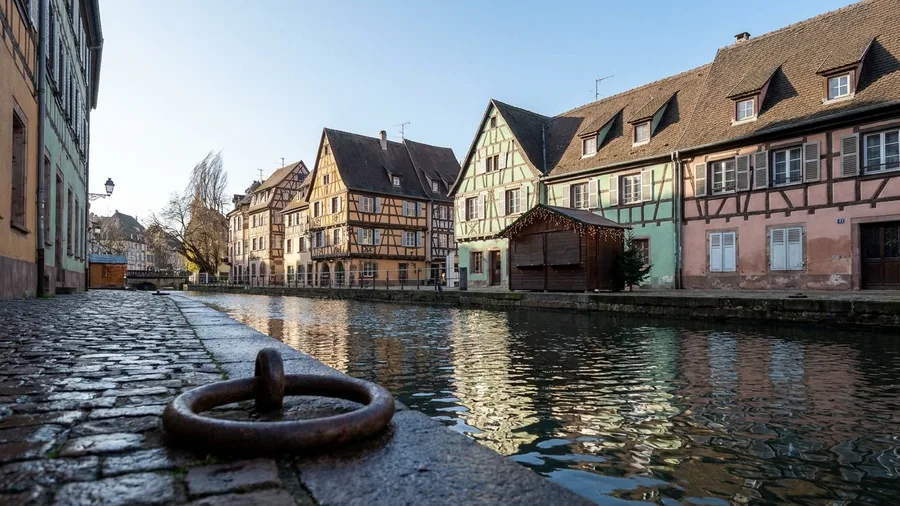
Colmar is the densest fairytale on this list, and that density is the whole argument. The old town runs end to end in 20 minutes on foot, and almost every lane in it is timber-framed houses in colors that look painted on. In December it sits at 28-40F and damp, so the postcard you get here is timber and lights, not snow. Five separate market sites are strung through those lanes, all within a 15-minute walk of one another, which means you can hit every one of them between lunch and dark without ever getting on a bus.
The two photo anchors are the canal quay at Little Venice, where the water sits still enough to double the facades, and the timbered stretch along Rue des Marchands. Both are free and both are short. The catch is the crowd, and the crowd here is coach groups, which means the queue is not a line but a wave that lands mid-morning and does not really leave until evening. Go on a weekday before 11am and the lanes are close to empty, with the light still low and the shutters barely open. After that, do your shopping and eat, and let the photographers have it.
Sleep in the old town at $110-$180 a night and the five markets are a walk from your door. Stay outside and you are driving into a car park on the edge and walking in cold, which costs you the whole point of the place. The town is not huge and it does not need to be.
💡 Tip: Start at Little Venice at 9am, work east through the markets, and finish at Rue des Marchands before the crowds build.
| Town | Best for | Snow odds in December | Nightly hotel | Days needed |
|---|---|---|---|---|
| Colmar | Timbered streets and five markets | Low, damp cold | $110-$180 | 1-2 |
| Strasbourg | City-scale tree and market base | Low, damp cold | $110-$180 | 2 |
| Bruges | Canal reflections and evening lights | Low, damp cold | $140-$190 | 1-2 |
| Rothenburg | Walled old town and local market | Moderate, not reliable | $120-$170 | 1 |
| Prague | Biggest squares and dawn bridge | Low, damp cold | $130-$200 | 2 |
| Cesky Krumlov | One composed river-bend view | Moderate | $90-$150 | 1-2 |
| Hallstatt | Dawn lakefront before the buses | High, reliable | $150-$220 | 1 |
| Bled | Alpine scene without Swiss prices | High, reliable | $90-$140 | 1-2 |
| Zermatt | Guaranteed snow and Matterhorn | Very high, near certain | $220-$320 | 2 |
| Rovaniemi | Polar dark, deep snow, aurora | Very high, deep snow | $220-$320 | 2-3 |
| Tallinn | Walled old town on a budget | Moderate | $110-$160 | 1-2 |
2. Strasbourg's giant tree and cathedral market
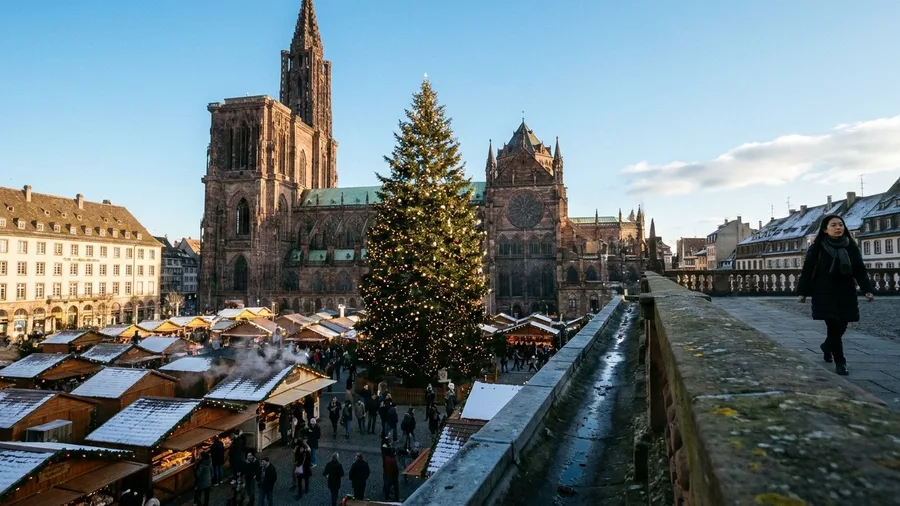
The first thing that hits you on Place Kleber is the smell: cinnamon and hot sugar, woodsmoke, and thirty meters of spruce rising out of the square with lights up every branch.
That tree is the set piece, and the walk from it is the argument for sleeping here. Strasbourg runs the same timber-and-lights look as the villages south of it, at city scale: a full cathedral market, the lanes of chalets at Place Broglie, and enough of both that you are not done in an hour.
The train to Colmar takes about 30 minutes and costs $8-$15 each way. So one bed covers two towns. You see the small one in the morning light, come back, eat a real dinner in a city that has restaurants open past nine, and never repack.
That is the honest trade against the village. More everything, less charm per square foot, better evening food. If the five markets in the smaller town felt like the whole picture, this is the same picture with a frame wide enough to hold a cathedral.
Hotels run $110-$180 a night, and staying inside the Grande Ile puts the tree, the cathedral and the Broglie lanes inside a fifteen-minute walk, with no tram rides in the cold. The one free thing that earns the stop on its own: the tree after dark costs nothing to stand under.
3. Bruges by canal light after dark
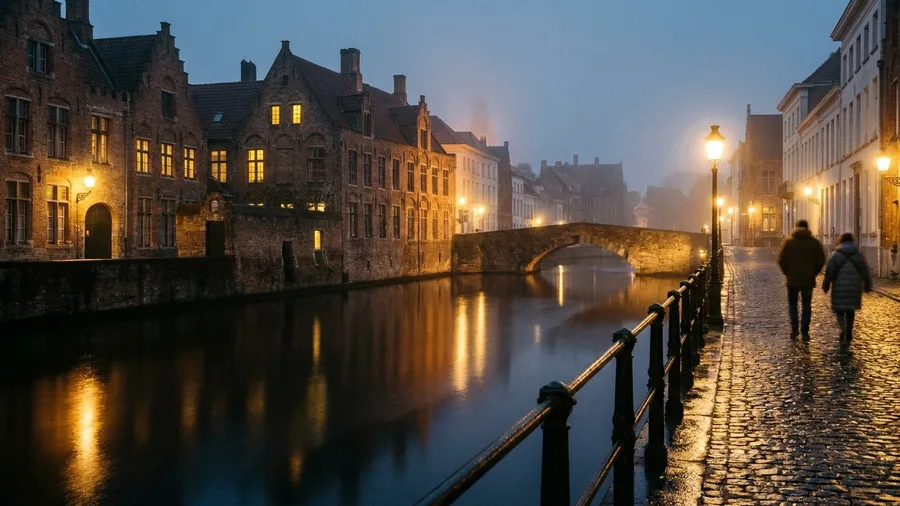
Twenty minutes is all the walking you need to cross the whole centre of Bruges, which is why the evening is the reason to sleep here. Day-trippers clear out by about 6pm, the coaches go, and the town that was shoulder to shoulder at three in the afternoon goes quiet and lit. The weather is 28-40F and damp, and the damp does the work: canal water holds the reflections, and the facades double in it. Skip the daylight version and save Bruges for after dark.
The two dusk stops are the ice rink on the Markt, where skaters go round under the lights with the bell tower above them, and the canal viewpoint at Rozenhoedkaart, where the reflections stack up between the brick gables. Both are free to stand at. Keep warm with the local version of the drink you came for: a hot chocolate thick enough to coat the spoon, or a gluhwein at 4-5 euros plus a 3-5 euro deposit on the mug, and a market dinner of sausage, bread and a drink for $12-$18.
Hotels run $140-$190 and climb on December weekends, so midweek is noticeably cheaper for the same town and the same lights. Stay inside the centre and the whole thing is on foot, no transport at all once you arrive. Book the midweek and the price gap pays for the chocolate.
💡 Tip: Stand on the Rozenhoedkaart bridge at 4:30pm in December, when the lights come on and the sky still has color.
4. Rothenburg's walled town and small local market
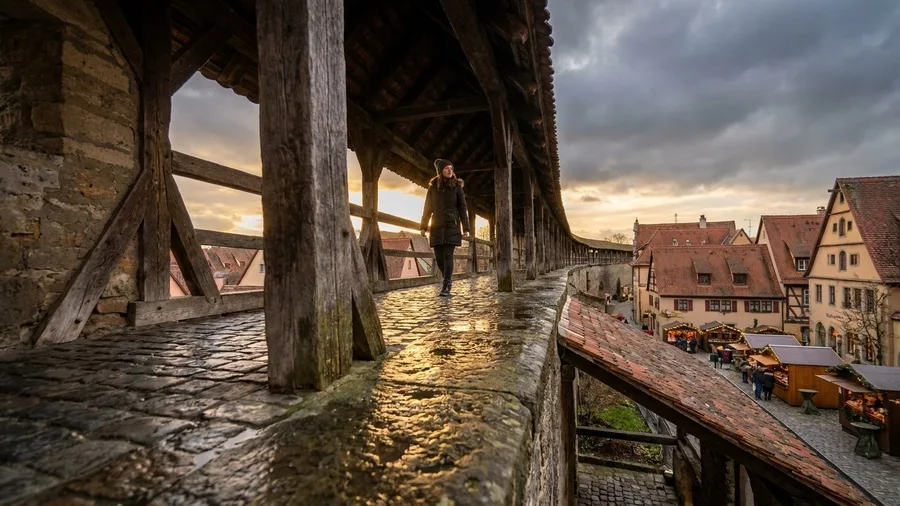
Before you book the walled-town fantasy, know that Rothenburg in December usually has no snow on it. The fairytale here comes from floodlit stone and timber, not a white blanket, so if the white blanket is what you came for, this is the wrong stop. What it does better than anywhere else on the list: the old town still sits inside a complete medieval wall you can walk on top of, roughly 1.5 miles around, and the December market on Marktplatz is a local one, not a production. That is what the $120-$170 a night pays for — not spectacle, but the genuine article.
The Reiterlesmarkt is small enough to cover in an hour, which is the point. Nothing is staged for you, and by midweek after 8pm the lanes are close to empty. Walk the covered stretch of the wall in the dark — it is lit, sheltered from the wind and entirely doable in the cold — and you get the oldest-feeling hour on the whole trip for free. Go midweek, and bring a hat.
💡 PRO TIP
The 11am Rule
In every town on this list, coach groups land between 10:30am and 11am. Get your photos and your market browsing done before then, and use the middle of the day for a long lunch or a museum.
5. Prague's two squares at seven in the morning
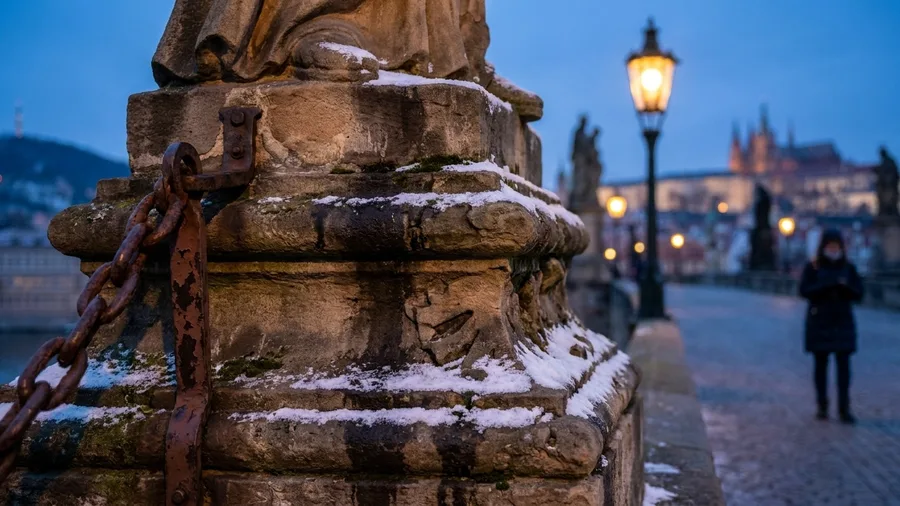
The big-city version of the market-and-old-town formula is worth it, but only if you use the clock against the crowd. Old Town Square is the main event; Wenceslas Square runs smaller and calmer as a second. Together they are the largest scale on this list, and at 28-40F and damp the fairytale only exists in two windows: before the crowds in the morning and after the lights come on at night. Between noon and dark, it is a crush.
The set piece is Charles Bridge, and you want it at dawn, when the statues and the castle silhouette line up without a single shoulder in the frame. Weekends from 5pm to 8pm Old Town Square is shoulder to shoulder. The fix is market dinners at $12-$18 instead of booked restaurants, and hotels inside the old center at $130-$200 a night so the early start costs you nothing but an alarm.
6. Cesky Krumlov and its river bend
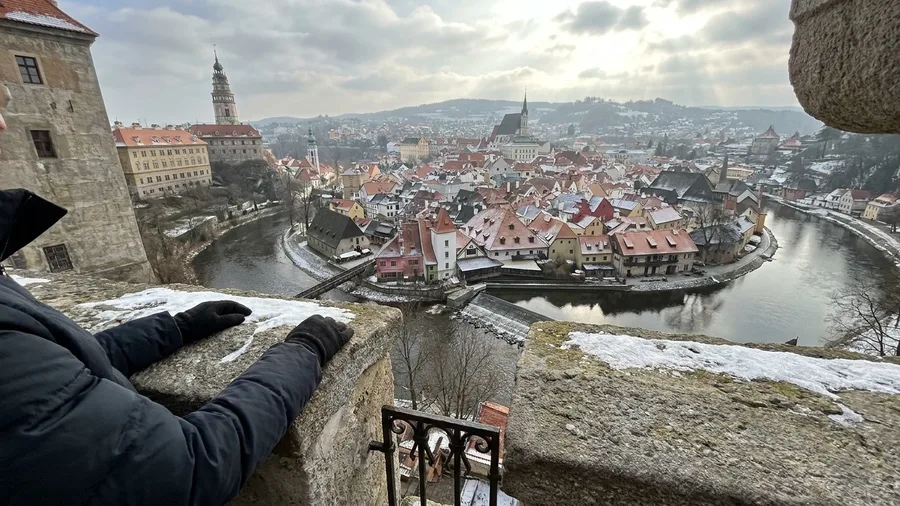
A city square at seven in the morning still asks you to work for the view, and this town hands it over for the price of a bus ticket. Cesky Krumlov is one arranged picture: the Vltava swinging wide around the castle rock in a horseshoe, the tower and the Cloak Bridge stacked above the water, red roofs packed inside the bend. Two vantages do the job. Stand on the Cloak Bridge itself, looking down the river corridor, or climb the castle tower for the whole loop in a single frame. In December twilight, somewhere around 4pm, the windows come on across the roofs and the picture fills in without a crowd in front of it. The Prague bus takes roughly three hours and costs $10-$15, which makes this the easiest two-night add-on on the trip.
Then the catch, and it is a real one: outside the day-tripper hours the town half-closes. Restaurant kitchens shut early, half the storefronts go dark, and by 8pm on a Tuesday you may find two places open and both full. Book the hotel dinner instead of hunting, or eat before seven. Rooms run $90-$150 a night, the best value on this list for the look, which is the reason to give it two nights rather than one. Sit on the terrace above the river with a gluhwein at 4-5 euros plus the 3-5 euro deposit, watch the lights come up in the bend, and do nothing for an hour.
💡 Tip: Climb the castle tower at 3pm in December for the last light on the river bend before the lamps come on.
Prague and Cesky Krumlov — At a Glance
🚌 Last bus back to Prague
Confirm day-of; afternoon buses thin out
🕗 Hours the town stays open
Kitchens shut by 8pm on weeknights
📷 When to have the bend to yourself
Before 11am, light and empty
💵 Cash to carry
300-500 koruna ($13-$22)
☕ Deposit back on the mug
3-5 euros, return the cup
The move
Book the hotel dinner before you arrive — outside market hours the kitchens close and the open tables fill.
7. Hallstatt at dawn before the buses
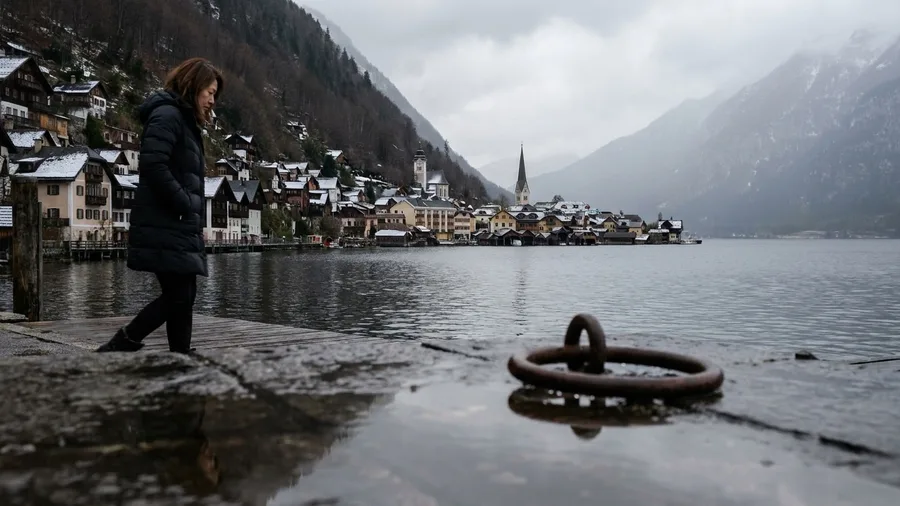
Yes, for about fifteen minutes, and those fifteen minutes are the whole bargain. The classic shot on the north shore, a village pressed between a cliff and the water at 20-32F with snow usually on the ground, is exactly as composed as the pictures suggest. The catch is that coach groups land mid-morning and the quay fills, so the version you pictured exists at dawn and again after 4pm and not much in between.
Sleep in town to be there for it, at $150-$220 a night for a lake view, because the view is the entire product, so pay for it or stay elsewhere and treat this as a day stop. Your second shot is the Skywalk above town, and the funicular up runs weather permitting; when it doesn't, the lakeside walk is the fallback and still puts you under the cliff with the water on one side.
Hallstatt and Bled by the Numbers
Two alpine options, two different bargains
8. Bled's island church under snow
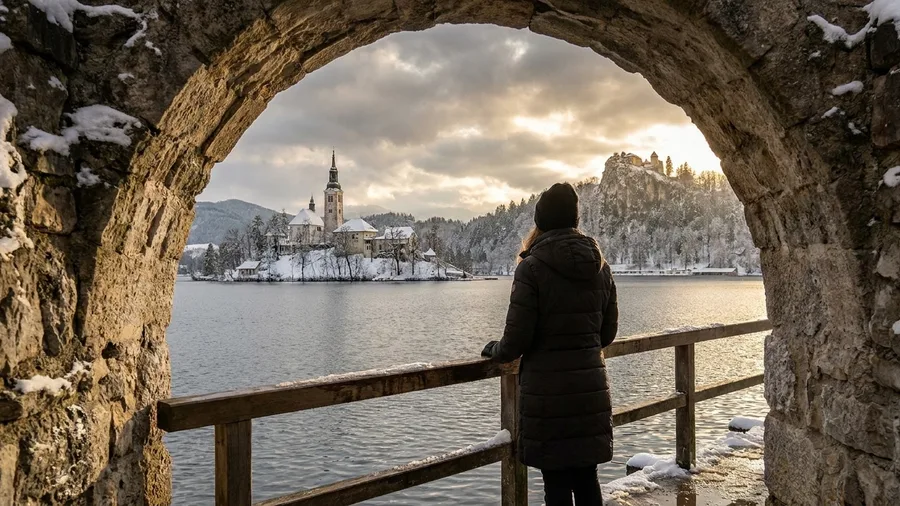
Cold comes off the water first, before you see anything, and the snow on the island church roof sits in a single unbroken sheet that nothing disturbs.
Lake Bled hands you the alpine postcard at the lowest price of any high-altitude option here: a church on an island with a bell tower, a castle up on a cliff face, and a cream cake in the pastry shop behind the rowing club. The temperature runs 20-32F in December with snow usually already on the ground. For what a Swiss lakeside hotel charges for parking alone, Bled gives you a full winter scene.
The 3.5-mile loop around the lake, about 1.5 hours on foot, is the thing to do the moment you arrive and your room key is still in your pocket. Walk it counterclockwise so the castle stays in front of you and the light falls on the island from the side, not behind. The rowboat over to the church runs weather permitting in December, so ask at the boatman's stand on the north shore when you get there, not before you book the trip.
The catch is smaller than Zermatt's price tag but bigger than you think: fog can sit on the lake for days, dropping the whole scene into grey and holding it there. Snow is reliable; visibility is not. Build one flexible day into your Bled plan so a clear morning does not go to waste, and keep the walk ready for whenever the cloud breaks.
The short climb up to the castle terrace gives you the view of the island and the lake below for free. Hotels run $90-$140 a night, which makes this the easiest place to stay two or three nights rather than passing through. It suits families with the lake path, older travelers who want it flat and short, and anyone watching the budget while still asking for alpine. If you came for guaranteed snow underfoot and guaranteed clear skies in the same trip, it is honest to say those two things do not come together here.
💡 Tip: Check the weather forecast the night before; if fog is forecast, shift your lake day and do the castle or a day trip to Ljubljana instead.
Guaranteed Snow vs. Lower Cost
Pay for snow
- Zermatt: Swiss franc, cards fine, carry 30-50 euros equivalent
- Rovaniemi: flight via Helsinki, no train
- Snow certain, daylight 3h50m at solstice
- Book 8-10 night trip by early fall
- Base here first, second base by train
Save on the look
- Bled: euro, 1.5-hour lake loop
- Cesky Krumlov: $10-$15 bus from Prague
- Snow reliable, fog is the risk
- Market dinner $12-$18, gluhwein 4-5 euros
- Before 11am squares empty, best light
9. Zermatt, where the snow is close to certain
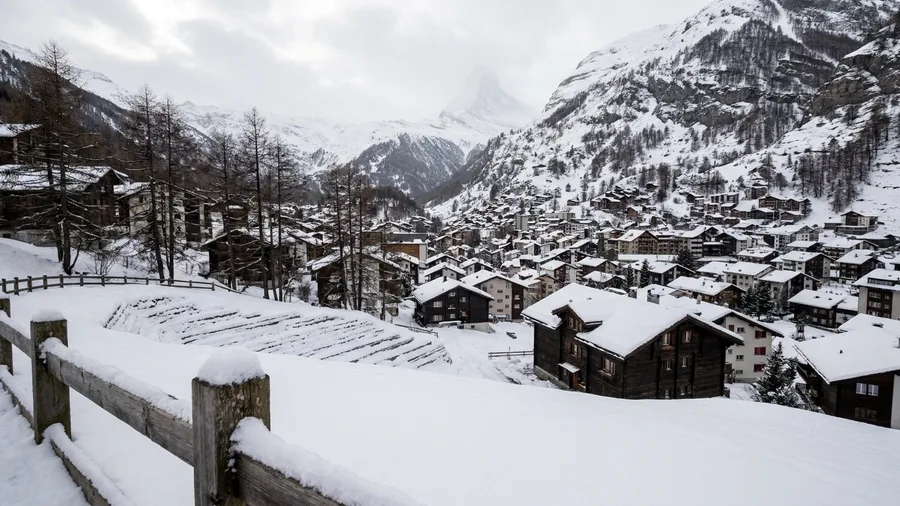
Two nights here cost $440-$640 in hotel alone, and that bill is buying one thing: snow on the ground you can count on, in a village with no cars.
The Gornergrat train, $60-$80 round trip, gets you up to the Matterhorn view, and a clear morning is when it pays. Go early, because December daylight is short and the mountain goes flat and blue by mid-afternoon. Then walk the village, which is the other half of the deal; arrival is by train from Visp, after which it is electric taxis and foot only.
The catch is the calendar. Some lifts are not yet open early in December, so a ski-focused trip wants the second half of the month, and the short days mean you plan around light rather than fitting things in. Come for the snow and the car-free streets for two nights, not five, and the price stays in proportion to what you came for.
10. Rovaniemi in polar dark and aurora light
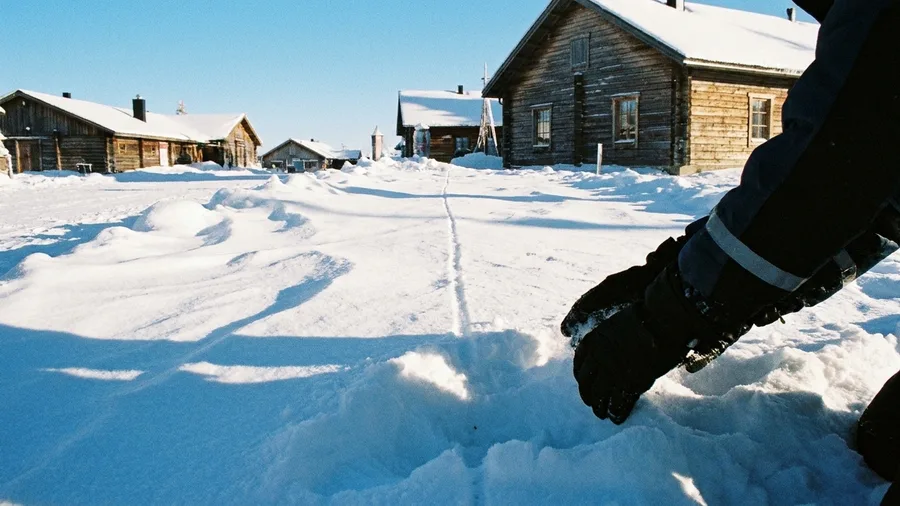
Rovaniemi is not a pretty town. Snow on the ground is the surest thing you'll find anywhere in Europe in December, but what you're buying here isn't timbered houses or market lanes. The temperature runs 10-25F, the drifts sit deep, and the town sits inside the Arctic Circle. On the solstice you get roughly 3 hours 50 minutes of daylight, and that thin blue band around midday is the whole point, not a problem to work around.
Santa Claus Village straddles the Arctic Circle line itself, a 20-minute bus ride out of the center, and standing with one boot in each imaginary hemisphere is worth half an hour of your afternoon. Aurora chase tours run $90-$130 a head, and every operator and most hotels loan out thermal gear, so skip the $200 parka you'd wear twice. The lights are never guaranteed, and a cloudy night means you burn the money and go to bed. Book the chase for your middle night and keep the other night loose.
Hotels run $220-$320, and that's the catch sitting in front of everything else: you fly in via Helsinki, December sells out early, and the cheap rooms go first. Lock lodging before you book the flight, not after. Two nights covers the dark and the lights without testing your patience for cold.
💡 Tip: Book the aurora chase for your first night; if it clouds out, you still have the rest of the trip to try again.
📋 How to Book the Trip in Six Steps
Check market dates
Confirm each town's market runs through your dates; some close December 22-24.
Lock the big-ticket lodging
Book Zermatt or Rovaniemi first; they sell out earliest for December.
Book flights
Fly into Frankfurt, Zurich or Prague; airfare runs $850-$1,150 round trip.
Reserve train legs
Book intercity trains early for $30-$90 a leg; some routes fill up.
Pick your bases
Choose two bases to minimize repacking; Strasbourg covers Colmar, Prague covers Cesky Krumlov.
Pack for the cold
Waterproof shell, wool layers, and a 30-50 euro cash reserve for market stalls.
11. Tallinn's walled old town on a budget
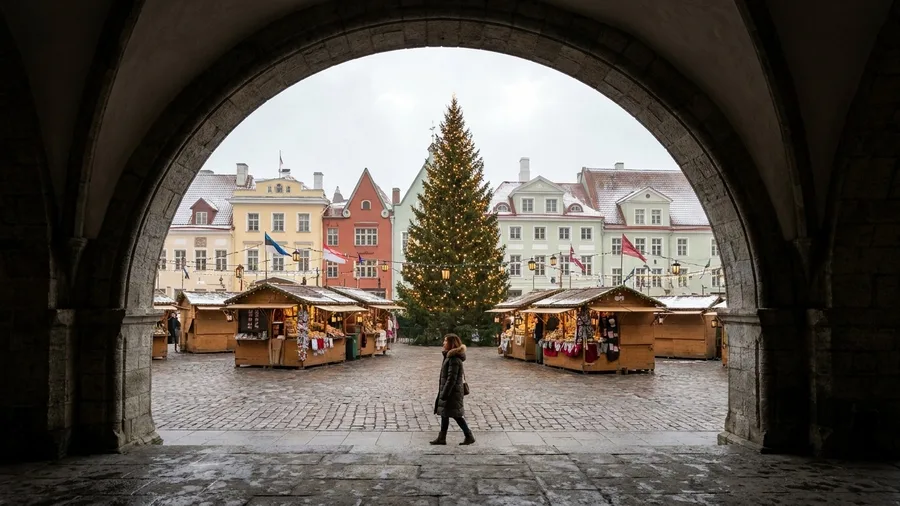
The catch: those six hours of daylight disappear fast. At this latitude in December the sky is grey by late afternoon, so your window for the walls, towers and Toompea hilltop is roughly 10am to 3pm – miss it and you are doing a medieval town in the dark, which works for the market but not for the ramparts. Plan the outdoor hours around the light.
After the deep Arctic and its prices, Tallinn is where the postcard gets cheap without losing its edge. The Town Hall Square holds the market and its tree, framed by gabled merchants' houses; above it, Toompea hill and the surviving wall towers give you the walking route that makes the town feel enclosed rather than staged. Hotels run $110-$160, and a gluhwein plus a market dinner still come in under $25 – the lowest of any capital here.
If you are already in Helsinki, the 2-hour ferry across the gulf runs $30-$50 each way, so the two cities become one trip. Book the crossing ahead for a December weekend.
Frequently Asked Questions
Is it worth visiting these towns in December if I don't like crowds?
Yes, if you time it right. Before 11am and after 8pm the squares are close to empty, and midweek is noticeably quieter than weekends. The 5-8pm window on Saturdays is the only time it feels truly packed.
Do I need to book trains in advance?
Yes for intercity routes, especially around December weekends. Prices run $30-$90 a leg, and popular routes like Prague to Cesky Krumlov fill up. Book two to four weeks out to get the lower fares.
Which town has the best chance of snow?
Rovaniemi and Zermatt are the safest bets, with deep snow almost guaranteed in December. Hallstatt and Bled usually have snow too. Colmar, Strasbourg, Bruges and Prague rarely get a white covering, so book them for lights and architecture rather than snow.
How much should I budget per day?
Outside the alpine stops, expect $120-$200 a day for hotel, food and market meals, plus train fares. Zermatt and Rovaniemi run $250-$350 a day because hotels start at $220. Budget another $100 for an aurora tour in Rovaniemi.
Can I do this trip in one week?
Yes, if you pick two bases and resist adding more. Strasbourg and Colmar in four nights, then Prague for three, covers three of the eleven towns and one big-city base. Trying to hit five towns in a week means spending half the trip on trains.
What should I pack for December in these towns?
A waterproof shell over wool layers, insulated boots with grip, gloves, a hat, and a small cash reserve of 30-50 euros. Alpine stops like Zermatt and Rovaniemi need a proper down layer. Bring a compact umbrella for the damp towns like Bruges and Colmar.
Two Days or a Week of December
Decide by situation, not by ranking. One week and a first trip: Strasbourg, old-town hotels at $110-$180, Colmar 30 minutes and $8-$15 by train, and you get two of the eleven looks without changing hotels. Snow that is actually on the ground: Zermatt, at $220-$320 a night plus the $60-$80 Gornergrat train, so two nights, not five. Cheapest town that still looks the part: Cesky Krumlov, $90-$150 hotels, a $10-$15 bus from Prague.
First move tonight is lodging in Zermatt or Rovaniemi, which sell out earliest for December. Then check each market's closing date on the town's tourism site before you book trains, since some shut a day or two early.
Which returns you to where this started: the famous city on the map is still the wrong purchase. The right one is the square that goes quiet before 11am, held for the price you agreed to pay.
Check Your Market Dates First
Before you book anything, open each town's official tourism page and confirm the December market runs through your dates. It takes ten minutes and saves a wasted train ticket.