Most people take the December trip and then buy the gifts anyway. We flipped the order: we told both families in September that there would be no presents, and five nights in San Antonio on December 23 to 28 became the whole thing. Two adults in Denver, 11 names across both families, and a December that got shorter every year. The last gift Christmas ran from a first shopping trip on October 12 to a last errand on December 22 and cost $1,900, with $210 of that shipping and $85 on wrap, cards and tape.
The swap did not make us rich. Flights for two, a hotel at $132 a night, food, two attractions and airport parking and rideshares came to $1,718, only $182 under the gift total. Then $31 went to each niece and $45 to a host gift for the January dinner, so the honest number is $75.
What actually moves is the gathering: five shared nights in place of wrapped objects. That pays only if your list already feels like unpaid work by November. If the giving is the point, or small Santa-believers are in the house, keep the gifts.
What follows lets you price your own version in September, see whether you fit the suit-or-not split, pick one relative to approach first, and check what is open December 24 to 26 before you book anything.
Quick Tips Before You Start
Announce in September
Tell family the second week of September, before anyone has started shopping. A December announcement reads as a rejection of gifts already chosen.
Book a kitchenette
Most restaurants in San Antonio were closed on Christmas Day. A kitchenette and a $78 grocery run on December 23 covered breakfasts and two dinners.
Check December 24–26 hours
Call ahead for restaurant and attraction hours on the three holiday days. A walkable downtown lets you test open blocks on foot instead of driving to a closed door.
Keep a short list
Children and the dinner host stay on the list. Adults exchange nothing. Word the rule as 'under 18 or hosting the January dinner' so no adult is ranked.
Set aside $215 a month
January through August out of the old gift budget puts $1,720 in the account by September, roughly the $1,718 trip total.
Name a fallback
If the trip falls through, say so in September: a $150 local experience day and the January dinner, not a silent return to presents.
The trade you're actually making
Before you propose this to anyone, you need to see what the swap actually replaces. It is not a vacation versus a pile of presents. It is a budget, a ritual, and about 18 hours of December labor.
This first group of entries runs the numbers and then the morning itself, because a swap that saves $75 has to earn its place on something other than cash.
1. The whole trip cost less than the gift list
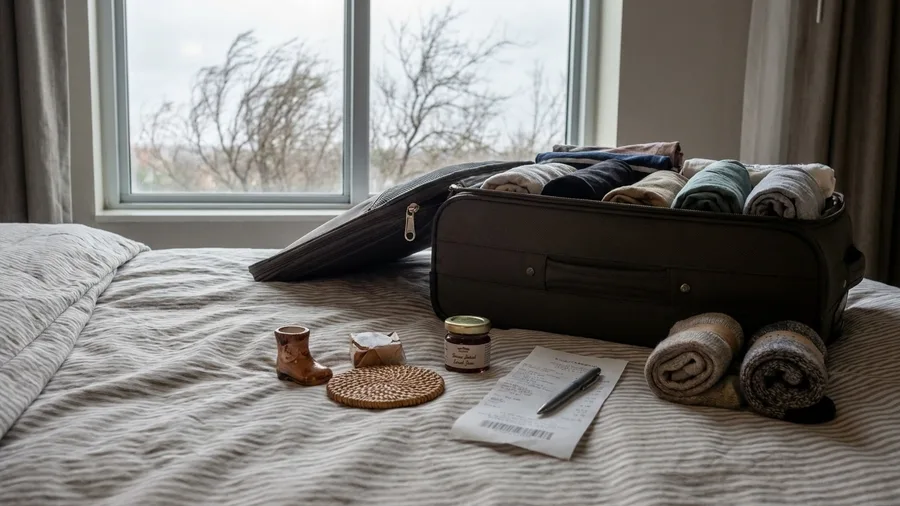
It did, but the number is close enough to grab lunch on. The last gift Christmas came to $1,900: $1,605 in presents, $210 in shipping, $85 on wrap, cards and tape, with shopping starting October 12 and the final box taped shut December 22. Five nights in San Antonio, December 23 to 28, came to $1,718. Flights for two were $560, the hotel $132 a night for $660, food $295, two attractions $88, airport parking and rideshares $115.
Two lines fell out of the budget entirely: the $210 shipping and the $85 of wrapping, because nothing went in a box to the tree. We still bought two nieces' gifts at $31 each and a $45 host gift for the January family dinner, $107 total, so $1,900 minus $1,718 is $182, not $75, until you subtract those gifts. Call it a wash-plus, not a windfall. Seventy-five dollars does not carry a decision this big, which is why the only question worth asking next is whether five hotel nights did the work a pile of wrapped objects used to do.
💡 Tip: Run your own gift total first, including shipping and wrap. If it doesn't beat your trip quote, the swap is a wash and you should say so out loud.
| Line item | Gift Christmas | Five nights in San Antonio |
|---|---|---|
| Flights (2 people) | — | $560 |
| Hotel (5 nights at $132) | — | $660 |
| Food | — | $295 |
| Attractions (2) | — | $88 |
| Airport parking and rideshares | — | $115 |
| Gifts | $1,605 | $107 (two nieces, one host) |
| Shipping | $210 | $0 |
| Wrap, cards, tape | $85 | $0 |
| Total | $1,900 | $1,718 |
| Net difference | — | $75 saved |
2. Nobody missed the presents once we were elsewhere

Eight forty-five on Christmas morning I was standing in a quiet hotel room with nothing wrapped to hand anybody. Coffee was already made in the kitchenette, the suitcase was open on the luggage rack, and the floor was empty of paper. It looked like an ordinary Tuesday morning in a Hyatt. That was the thin moment, the one I had braced for, and it lasted about four minutes, until a photo of my nieces in their Christmas pajamas came through on my phone.
The morning had a shape, though, and the shape was the whole point. We woke at 7:10 and made coffee; at 8:00 we pulled the stockings out of the suitcase and opened them on the end of the bed; at 9:00 I scrambled eggs with bread and fruit from the grocery run; at 10:30 we walked the River Walk while it was still half empty; at 11:00 we called both families in turn and got passed around the rooms. Stockings cost $40 total and they were packed flat between the shirts. They survived the trip because they were a ritual, and rituals travel. The wrapping paper never did.
My nieces opened the gifts we sent them at the January 14 dinner instead, at our dining table, six weeks after the fact, and they were entirely fine with it. They had already had their own Christmas morning at home with their parents, the tree, the grandparents, the whole production. What we shipped them was extra, not essential, which is a useful thing to learn about your own place in a child's Christmas.
Here is the test for you. If what makes the day for you is the moment a box passes from your hand to someone else's, and you watch their face, this week will feel like an empty morning with better weather. If what makes it is a shared breakfast, a call to your mother, and a walk with coffee in your hand, the swap just replaced the wrapping-paper frenzy with something you can actually remember.
3. No decorating, no hosting, no December 26 cleanup

The presents were the visible part. What disappeared with them was the preparation, and that is the change to December I feel most. Under the gift regime I logged 14 hours of shopping between October 12 and December 22 and 4 hours at the dining table with paper, tape and a list, 18 hours that came back to me the year we flew out on the 23rd.
The $240 Christmas Eve hosting went with it, and so did the decorating and the December 26 cleanup, because five nights in a hotel room gave us no tree to trim, no chairs to arrange and no carpet of paper to vacuum at eleven at night. The $210 shipping line was never only money. It was a calendar: every box had to clear the post before mid-December or arrive late and apologetic, and that deadline ran the first two weeks of the month like a second job with a hard close.
This is the entry that tells you whether you are the right household for the swap. If December has become a list of tasks you perform for other people, 18 hours and a $240 party are the largest savings in the whole trade, bigger than the dollars and gone in a single booking. If a trimmed tree, a set table and a house full of people on the 24th are the point of the season for you, the trip takes something real and you should keep the hosting and travel in January instead.
⚠️ COMMON MISTAKE
Announcing in December is the mistake
We told both families the second week of September, before anyone had bought a thing. Announcing in December lands after the shopping has started and reads as a rejection of gifts already chosen. Say it in September or don't say it.
The friction, and who it doesn't suit
4. The grandparents took it harder than the kids did

You say it in the second week of September, and you can hear the phone go quiet before anyone answers. Four reactions, almost word for word. My mother: so Christmas is canceled. My father: your call, said flat, which from him is a shrug. His father: Christmas is family, not a vacation. His mother said nothing about it at all and instead told me what she was sending in the mail.
the 18 hours you just took off your December are invisible to them, and the empty space under the tree is not. September was the only month that worked, because nobody had bought yet. Say it in December and it lands as a rejection of a gift already wrapped and tagged. My parents softened once the January 14 dinner actually happened at our house, and his mother accepted the date first, before her husband did. His father was still lukewarm into the second year. The nieces never objected at all, which told us the objection belonged to the adults and was about the shape of the holiday rather than the size of a child's haul. Expect to lose one relative's enthusiasm for a while. That is the price of the trade, and it is not refundable.
💡 Tip: Raise it as an invitation to a January dinner, not as a rejection of presents. The date on the calendar does more work than the argument.
5. We didn't quit gifts entirely — two nieces, one host

Know before you announce anything: you cannot go all-or-nothing. Wipe out every gift and you do not save money, you insult the people who were counting on the exchange. So we kept a short list instead. Two nieces at $31 each, $62, plus a $45 host gift for the January 14 dinner, $107 in total.
The rule went out word for word to both families: under 18, or hosting the January dinner. That way no adult was ranked and nobody was named as cut off. The children stayed on the list because they would feel the absence; the host stayed on because she was feeding us in January. My parents' resistance had set that limit, and the limit is what held the peace.
One hard exception. If there are young Santa-believers in the house, keep the gifts. Santa is a separate promise, and a Christmas-week trip can collide with the morning at home when a child expects to wake up to it. Those households should keep the gifts and take a smaller trip in January, after the Santa morning, rather than cancel the thing the children believe in.
6. This only works if gift shopping is a chore

In a bookstore in October, with the heat on and the paper smell rising off the new-fiction table, I picked up three novels for my father-in-law and put one back. That afternoon is the thing I miss. When you cut the adult list to zero, you lose both halves of a gift: the search and the two weeks of waiting for his reaction.
So price your own December before you decide. If the list reads as deadline and dread, a swap takes the weight off; if you get ideas in October and enjoy the hunt, keep the gifts and take the trip anyway. Mixed feelings point to paring the list, not canceling it.
Keep the gifts or swap them?
Swap to a trip if…
- Your gift list feels like unpaid work by November
- You can announce it in September, before anyone shops
- No young Santa-believers are in the house
- You can set aside about $215 a month from January
- You'll host a January dinner as the peace offering
Keep the gifts if…
- Choosing presents is the part of December you love
- Children still believe in Santa morning at home
- The family gathering is the point, not the gifts
- You can't get away between December 23 and 28
- A $75 net saving wouldn't justify the friction
The friction, and who it doesn't suit
The money is the easy conversation. The December that first year was not.
My mother heard the plan and said, flatly, that Christmas was canceled. My father said it was our call. His father told me Christmas is family, not a vacation. His mother said she would still send gifts, which was somehow the sharpest of the four, because it meant she had heard us and chosen to keep the old arrangement anyway. My parents came around once we set the January 14 dinner date at our place. His mother accepted the dinner before she accepted the trip. His father stayed lukewarm into the second year, and I stopped pretending otherwise.
We told both families in the second week of September for one reason: nobody had bought anything yet. Late December would have landed after the shopping, and then our decision becomes a rejection of a gift already chosen and paid for.
So the short list did the peacekeeping. Two nieces got $31 gifts each. Whoever hosts the January dinner gets $45. We worded it the same way to both families — under eighteen, or hosting — so no adult felt sorted into a category and no one got singled out as the one worth cutting off.
All-or-nothing is what insults people. A stated short list keeps the budget and keeps the ones who would feel the absence.
7. The guilt faded by the second year

Expect the guilt. Plan for it the way you plan the flight, because it arrives anyway. Ours peaked at 9:20 on Christmas Eve, in a hotel room that had gone quiet after we passed on the $95-a-head prix fixe downstairs and ate leftovers from the kitchenette instead.
I dialed my parents' house and got the whole room at once: my brother's laugh, a chair scraping, someone asking who was on the phone. I said we were fine, the room was nice, the trip was good. Then I hung up and the quiet came back and I sat there feeling like the one person who had opted out of a family. What pulled me out was my sister, who called the next day and said, plain as anything, that we would be at her table on January 14 and that was the visit. What pushed me back under was a friend who told me you only get so many Christmases with your parents, which is true and also the least useful thing anyone said all month.
Year one we answered every silence with a paragraph of explanation and braced for a verdict that never quite came. Year two we did the same five nights in San Antonio, December 23 to 28, and sent the January 14 dinner date out with the announcement in September, and nobody argued. So keep the dinner date, make the December calls even when the room is quiet, and do not buy a gift in a weak moment to settle your own stomach. That single package teaches your family the decision was never firm. The guilt is a cost of the transition, not evidence you got it wrong, and it shrinks once the calls and the January table do the work the packages used to.
You'll be here January 14 — that's the visit.
— What my sister said when the guilt hit
Making it work
Once the decision is made, the trip has to be booked and checked like any other trip. This group is the mechanical part: when to book, where to go, and what to do in the year you can't travel at all.
Get these four wrong and the savings disappear or the Christmas Day dinner is a closed door.
8. Book in September, when Christmas flights are cheap

Booking early costs you nothing but a calendar reminder. Booking late costs more than the entire swap saves. On September 8 we locked five nights in San Antonio, December 23 to 28: $560 for two round-trip flights and $660 for the room, $132 a night, with a kitchenette that I would pay a premium for and did not have to. When I checked the same route in November out of curiosity, it came back at $840 for two. Same seats, $280 more, and that check is one route, not a law about Christmas airfare.
The money part is the part nobody explains well. From January through August we moved $215 a month out of the old gift budget into a separate account, which put $1,720 in hand by early September, within a few dollars of the $1,718 the trip actually cost. We were not saving up for a trip so much as redirecting money that already left the house every December anyway. If you want the photograph everyone takes, it is the River Walk at dusk, and the way to earn it is to have the flights and the room booked before you spend a dollar on anything else. Food and attractions come after the two big line items are settled, and the kitchenette is what covers you when the city goes quiet on the 25th.
One caution before you tell a single relative. If September fares on your route come in high, the swap can lose on cash as well as on goodwill, and you need to re-price the whole trip in the same quiet way, with the kitchenette and the food line included, before anyone hears about it. A cheap fare and a room with a stove are what keep the decision from becoming a regret.
For the view that people actually remember, walk to the River Walk footbridges at the south end near dusk, stand on the arched bridge a few steps back from the tour boats, and wait until the string lights come on and both banks are lit at once. Go on the 23rd or the 24th if you can. The lights that make the shot run to the water, the sky is still a deep blue rather than black, and the crowds have not yet arrived.
💡 Tip: Put the trip money in a separate account and fund it monthly. A single December booking is what pushes Christmas trips over the gift budget.
Five nights in San Antonio — At a Glance
📅 Dates
Dec 23–28
✈️ Booked
September 8
💵 Total cost
$1,718
🛏️ Hotel
$132/night
🍳 Kitchenette
Yes
🍽️ Christmas Day dining
Mostly closed
What saved the day
A $78 grocery run on December 23 turned the kitchenette into breakfasts and two dinners when the restaurants were shut.
9. Not every destination is open on Christmas Day
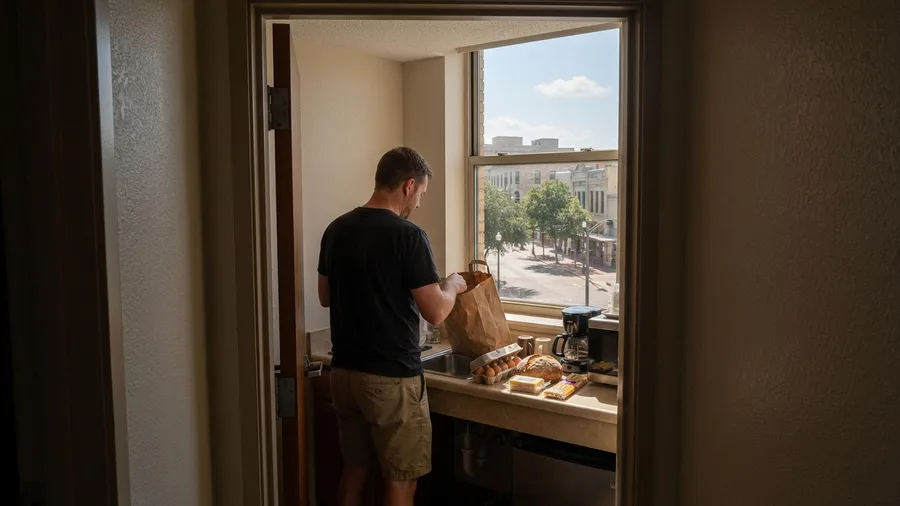
San Antonio has a walkable downtown that stays partly open through the holiday, and that is the reason we chose it over a resort. A cheap fare to a city where the kitchen is dark on the 25th is not a bargain; it is an expensive room with nothing to do.
On December 23 we walked to a grocery store and spent $78 on eggs, milk, coffee, bread, cheese, fruit, pasta, sauce and snacks. The room's kitchenette turned that bag into breakfasts and two plain dinners. The River Walk hotel wanted $95 a head for Christmas Eve, $190 for the two of us, and we passed; most restaurants in town were closed on Christmas Day, so the fridge did the work. A resort with a compulsory holiday dinner bundles that meal into the rate and takes the choice away. A downtown you can cross on foot and a kitchenette keep it.
Before you book, call the restaurants and attractions you actually want and ask about December 24, 25 and 26 hours, not the week of. Walkability is the test: from a downtown room you can check three open blocks on foot in an afternoon instead of driving to a locked door. Closures and holiday surcharges are the hidden line items of a Christmas trip, and the kitchenette plus that three-day hour check is the insurance.
10. Have a fallback for the year you can't travel

You take one experience day close to home and keep the January dinner on the calendar. A bad year should not quietly hand everyone back their gift list.
Ours would be a hot-springs day an hour out of Denver with lunch, roughly $150, in place of the five-night flight. Say it out loud in September, when you announce the trip: this is a one-year pause, not a return to gifts. Decide by early November, because by December the shopping has already started and a pause announced then reads as a retreat.
If a trip ever fell through, we would book refundable fares and keep both the January dinner and the $150 day rather than reopen the gift question. The fallback leaves a date and a ritual standing, so a missed year costs you a flight, not the whole swap.
📆 The swap, from September to January
Second week of September
Tell both families and offer a January dinner date at your place.
September 8
Book flights and a hotel room with a kitchenette for December 23–28.
November
Re-check flight prices and confirm the fallback for a year you can't travel.
December 23
Do the grocery run and stock the kitchenette before the closures start.
December 24–26
Keep the stocking ritual, make the family calls, and use the kitchenette for meals.
Early November (decision)
Confirm the fallback out loud so nobody buys presents in the meantime.
January 14
Host the dinner, exchange gifts with the nieces, and close the loop.
Frequently Asked Questions
Is it actually cheaper to take a trip than to buy Christmas gifts?
For us it was $1,718 for five nights in San Antonio against $1,900 for the last gift Christmas. After $107 in nieces' and host gifts, the net saving was $75. That is a wash-plus, not a windfall. Run your own gift total including shipping and wrap before you assume the trip wins.
How do you tell family without causing a fight?
Tell them the second week of September, before anyone has bought a thing, and pair the announcement with a date: a January 14 dinner at your place. Announcing in December lands after the shopping has started and reads as a rejection of gifts already chosen.
What if there are young children who still believe in Santa?
Keep the gifts. Santa is a separate promise, and a Christmas-week trip can collide with the morning at home. Those households take a smaller trip in January, after the Santa morning, rather than canceling the thing the children believe in.
When should we book the trip?
Book in September. We booked September 8 and paid $560 round-trip for two. When I checked the same flights in November they priced at $840 for two. That is one route on one check, so re-price your own before relying on it.
What do you do about meals on Christmas Day?
Most San Antonio restaurants were closed on Christmas Day. Book a room with a kitchenette and do a grocery run on December 23 — ours was $78 for eggs, milk, coffee, bread, cheese, fruit, pasta, sauce and snacks. Call ahead for December 24–26 hours before you go.
Won't it feel selfish to skip gifts?
The first year, for about an hour on Christmas Eve. What helped was keeping the January dinner date and making the Christmas calls. What did not help was buying a gift to soothe myself, because reopening the gift debate teaches the family the decision is fragile.
Price it in September, then say it as an invitation
Be blunt about whether you fit. This works for couples and families with no small Santa-believers, where the gift list has turned into unpaid work by November. It does not work where the giving is the point, or where children still expect the tree on the 25th. Decide that first, before you say a word to anyone.
Then price it in September, quietly. Quote the flights and a kitchenette room, subtract the nieces' and host gifts, and check whether you beat your own gift total by more than $75. Only after that do you raise it with one relative, as an invitation to a January dinner at your place, not a rejection of presents.
Because the Christmas being swapped out is real: 11 names, $1,900, $210 shipping, $85 on wrap, October 12 to December 22. The five nights cost $1,718 and cleared $75. The trip did not cancel Christmas; it replaced the December job that had grown around it.
Run the numbers this week
Add up last December's gifts, shipping and wrap. Then price five nights with a kitchenette for December 23–28. If the gap is under $200, decide whether the ritual is worth the swap before you tell anyone.