Which of these ten should you actually build a long weekend around? The one whose dates, weather and rail leg you already have – not the one that photographs best.
You have seen the Nuremberg and Strasbourg photos. You want the smaller, quieter December for one long weekend, not another queue for the same mug.
The ten markets here run 35 to 90 stalls and can each be walked in an evening. Central guesthouses in these towns run EUR 70-110 a night against EUR 180-250 in Nuremberg or Strasbourg, stalls close between 20:00 and 21:00, and only Bruges is still running after 26 December.
So the question is not which market looks best on a screen. It is which one fits the calendar you have, the forecast you are gambling on, the cash in your pocket and the last train you can catch.
Pick one, fix the dates, decide the exact hour you will turn up and whether you need cash, set the lodging budget, and check the Advent dates for the year before you book any transport. The rest can wait until next December.
Quick Tips Before You Start
Advent Monday to Wednesday
The quietest window at every one of these ten is a weekday evening before 19:00; stalls close between 20:00 and 21:00.
Carry small cash
Bautzen, Kaysersberg, Pécs and Trenčín are still mostly cash; break a €50 note before you arrive.
Arrive by rail
All ten are walkable from a station; the longest walk is 15–20 minutes from the platform.
Book the guesthouse early
Central doubles run €70–110 a night in December; the €250 Nuremberg price is not the only option.
Bring a deposit coin
Mugs carry a €3–5 deposit (about 12 lei in Sibiu), refunded when you return the cup.
Check the Advent dates
Kaysersberg runs weekends only, so confirm the year's calendar before booking transport.
1. Bruges: a market that outlasts Christmas
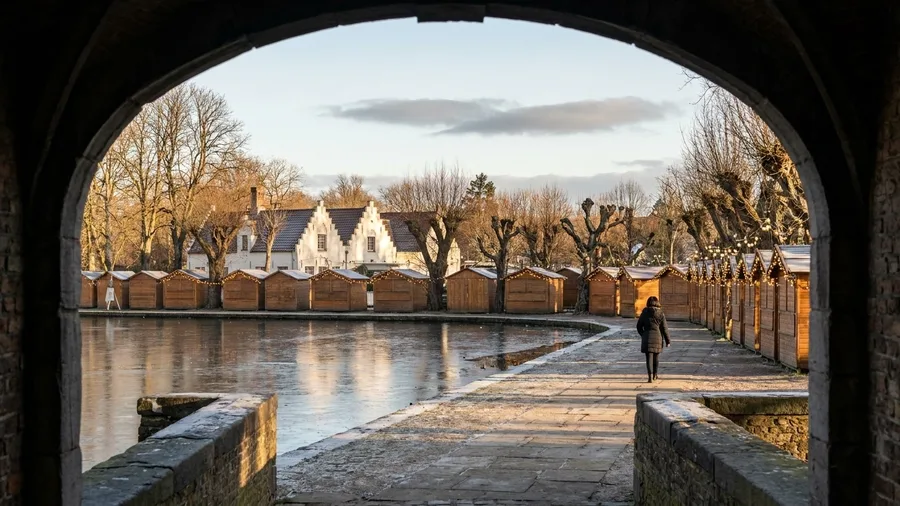
Book Bruges if your December is already spoken for and the only free days you have fall between Christmas and the first week of January. It runs from 25 November to 7 January, and it is the one market here that is still standing after 26 December, which matters if your calendar filled up before you got to it.
The stalls sit along the Minnewater lake, roughly 60 wooden cabins under bare trees, and you reach them on foot 15 minutes from the station, no taxi and no tram. Come at 16:00 in the first week of January, when the light drops and the strings come on and the lake holds the reflection. Order a warm jenever for the cold and a paper cone of frites for the salt, and pay by card at the stalls, so there is nothing to plan around cash. Pair it with the Groeninge and the Memling in the daytime and you have a couple's long weekend in which the museum hours and the market hours do not fight each other. What you give up is the Advent climax, the last-week-of-December crush that makes Nuremberg what it is; what you get back is the same 60 stalls, the same walk from the platform, and room to stand at the railing without an elbow in your back.
💡 Tip: Arrive at 16:00 in the first week of January and pair the market with the Groeninge and Memling museums while they are empty.
| Market | Country | Dates | Stalls | Getting there |
|---|---|---|---|---|
| Bruges | Belgium | 25 Nov–7 Jan | 60 | 15-min walk from station |
| Valkenburg | Netherlands | 15 Nov–5 Jan | 50 | 20-min train from Maastricht |
| Kaysersberg | France | Advent weekends only | 40 | 30-min bus from Colmar |
| Triberg | Germany | 1–23 Dec | 45 | 75-min rail from Offenburg |
| Bolzano | Italy | 28 Nov–6 Jan | 90 | 3-hr rail from Verona |
| Graz | Austria | 20 Nov–24 Dec | 70 | 10-min tram from station |
| Bautzen | Germany | Advent–22 Dec | 55 | 45-min rail from Dresden |
| Pécs | Hungary | 1–23 Dec | 45 | 2.5-hr train from Budapest |
| Trenčín | Slovakia | 1–22 Dec | 35 | 1 hr 20 from Bratislava |
| Sibiu | Romania | 24 Nov–26 Dec | 90 | 11-hr night train from Budapest |
2. Valkenburg: fifty stalls inside a cave
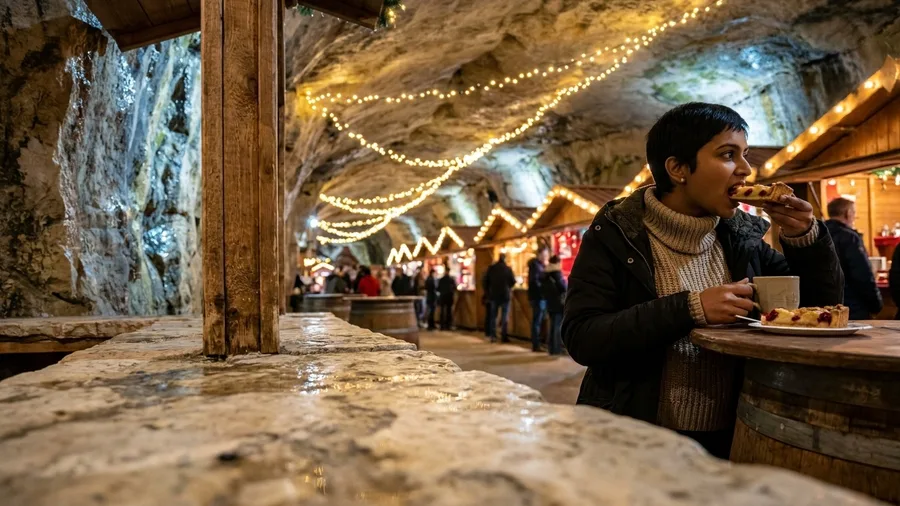
Then you want the market that does not depend on the sky, and Valkenburg has put about 50 of its stalls inside the Gemeentegrot, a lit limestone quarry, running 15 November to 5 January with timed entry around €7.
You step off the street and into a cave: a low ceiling strung with lights, the damp smell of stone, and the cold replaced by something close to still air. Locals treat it as the sensible option rather than the showy one, which is why it holds up on a wet Saturday when the outdoor markets empty.
Eat standing at a barrel table. Vlaai by the slice is the local tart, and it goes with warm chocolate milk rather than glühwein – sweeter, and the thing children in Limburg grow up on.
The market sits 20 minutes by train from Maastricht, so it slots into a Dutch city break rather than becoming a trip of its own. Book a 15:00 entry, walk the stalls in 90 minutes, and the evening is still yours for Maastricht.
What you give up is street daylight for a lit cave ceiling, and you get weather-proof certainty and 50 stalls for about €7. For a family or a forecast you do not trust, that is the trade to make.
A Cave Entry in Four Steps
3. Kaysersberg: one street, Advent weekends only
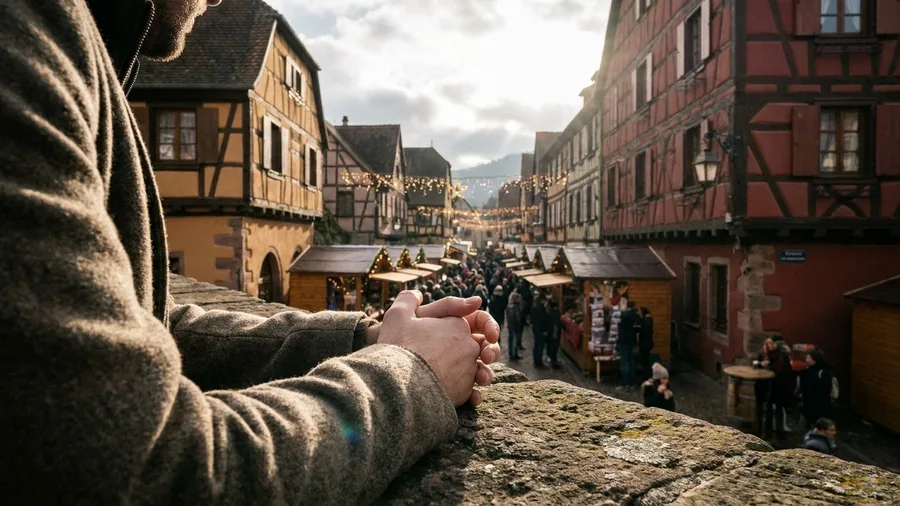
Kaysersberg is one village street and a fortified bridge over the Weiss, and the market only opens on Advent weekends – Friday to Sunday, like the small towns that have barely changed. Visit midweek and there is nothing to see; that is the trap worth flagging before you book anything.
About 40 stalls fill the Grande Rue, walkable end to end in 30 minutes and the smallest on this list. Stand on the bridge before 16:00, while the light still holds, for the shot the trip is remembered by. Bredala biscuits and a glass of Alsace mulled wine are the buy, most stalls take cash only, and a weekend guesthouse at €70-110 a night is worth booking early – the trade is a single street instead of event scale, with the calendar risk carried by you.
💡 Tip: This is the smallest and most photographed of the ten; the trade is any event scale for a village street, with the calendar risk carried by you.
⚠️ COMMON MISTAKE
Do not day-trip Triberg from Strasbourg
The 75-minute rail leg from Offenburg plus the uphill walk from the station makes Triberg realistic only with an overnight. A day return leaves you arriving after the light has gone.
4. Triberg: Black Forest stalls below the waterfall
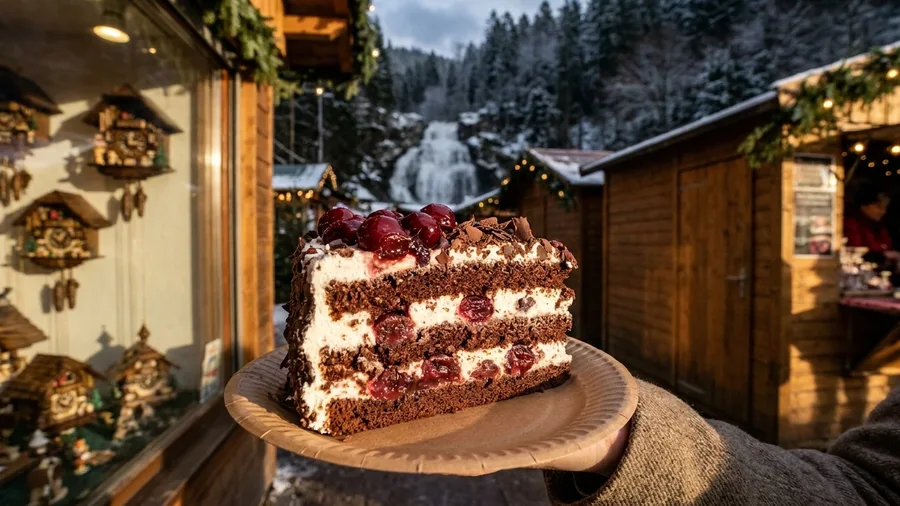
Seventy-five minutes by train from Offenburg, plus an uphill walk from the station that takes another fifteen, and you are standing among the stalls. That is the honest arithmetic of Triberg, and it is why this one is an overnight rather than a day return from Strasbourg, however tempting the map looks.
The market itself runs 1 to 23 December, about 45 stalls strung along the Hauptstrasse below Germany's highest waterfall, which is still pouring in the cold. Cuckoo clocks stare out of the shop windows behind the wooden huts, not as a joke but as the town's actual trade. The buy here is Black Forest cake by the slice, cherries and cream and a serious amount of kirsch, and gluhwein served in a boot-shaped mug you will end up carrying home.
Commit to one night, arrive around 16:00 once the climb is done and the light has gone blue over the falls, and walk the forest paths the next morning before the train back. What you give up is city density, the square packed with stalls and options in every direction; what you get is a waterfall, a clock-shop main street and a village small enough that 45 stalls feels like plenty.
💡 PRO TIP
The mug deposit is a game
Mugs carry a €3–5 deposit (about 12 lei in Sibiu). Keep the coin separate from your cash and you will never hunt for it at the end of the night.
5. Bolzano: an Italian market with Austrian habits
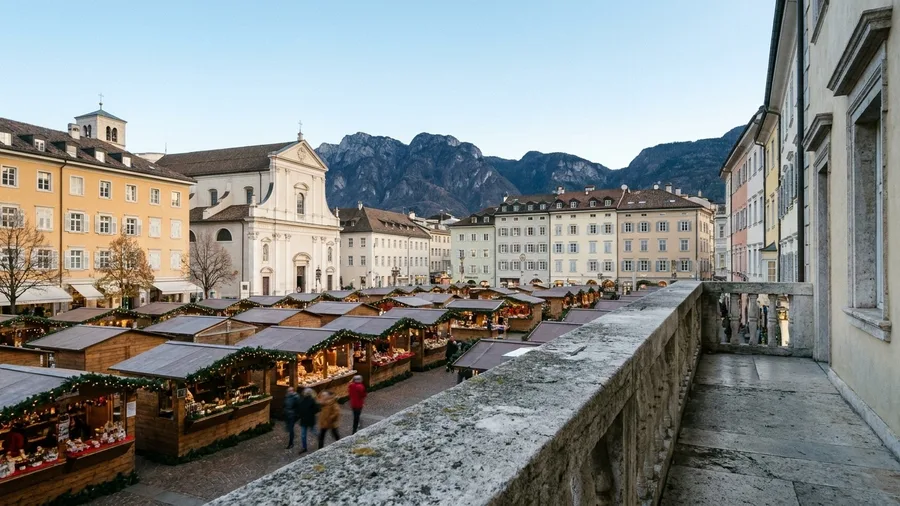
The smell hits first: Zelten, the dense fruit bread of the region, sweet with figs and spice, drying on racks behind the stalls while snow sits on the Dolomites at the end of the square. Piazza Walther fills from 28 November to 6 January with around 90 stalls, the biggest number on this list, and the setting behind them is the reason to come.
The drink is the tell. Mulled wine here comes white rather than red, poured hot and sharp against the cold, and the mug you drink it from carries a deposit of about 5 euros you get back at the end. Take the cable car up to Ritten or the Messner Mountain Museum during the day, then ride down and walk the market at 17:00 with the lights coming on and the mountain wall going dark behind the stalls.
The three-hour rail run from Verona drops you in an Alpine town with Austrian habits and Italian ease, and most stalls take cards, so you are not hunting for an ATM before your first mug. It is a square rather than a village, spread over five weeks, so it trades some intimacy for a genuine city stop with mountains on top of it. Bolzano is also your less remote option if a forest market's uphill walk and overnight felt like more commitment than you wanted.
Village Market vs City-Square Market
Village (Kaysersberg, Triberg, Trenčín)
- Walk end to end in 30–40 minutes
- Carols and cake in the local language
- Guesthouses at €70–110 a night
- Cash is the default
City-square (Graz, Bolzano, Sibiu)
- 70–90 stalls across several squares
- Museums, shops and trams on the same trip
- Cards accepted at most stalls
- More English heard around the stalls
6. Graz: Advent spread through the old town lanes
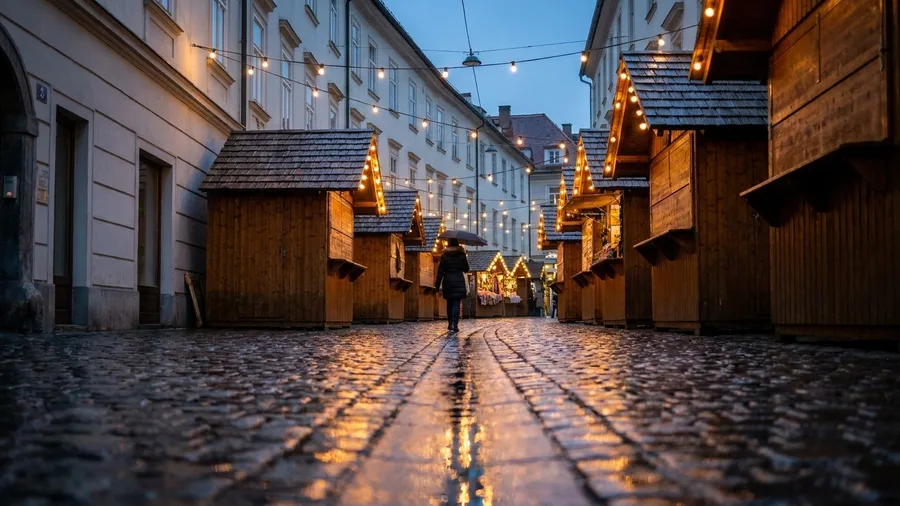
Do not come here expecting one square you can walk in a loop and be done. Graz spreads its Advent across the Hauptplatz and the surrounding lanes, around 70 stalls set into streets people actually live in, and the mistake is to arrive on a Saturday evening and wonder what the fuss is about.
Timing is the whole game. Advent Monday to Wednesday, after 17:00, the lanes are walkable and every stall still has what it had on Friday. Weekends bring the crush, the same queue you flew south to escape, and it lands on a market small enough that it has nowhere to spread.
Come on a quiet weeknight for the opposite of a fenced pen. The 10-minute tram from the station drops you into the centre and you can do the whole thing car-free: museums through the afternoon, shops on Herrengasse, then the lanes as the lights come on.
Lebkuchen, dense and spiced and sold by the slab, and Gluhwein to carry while you walk, because here you are walking rather than standing at a bar. Stalls close between 20:00 and 21:00, so plan dinner after the market rather than before it.
What it costs you is the contained spectacle, the single square lit up for a photo you can put away in one hour. What it gives back is a real city's December, spread through the old town, free to wander, and small enough that a weeknight feels like yours.
7. Bautzen: Sorbian carols and a Wendish cake
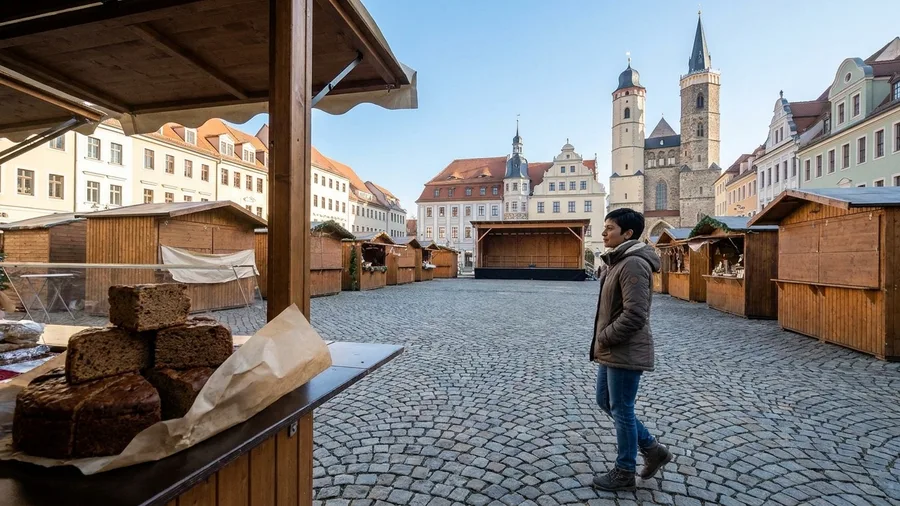
The first thing that reaches you is a carol in a language you can't place, coming off the wooden stage above the square, and then the smell of a dark, spiced cake from the stall beside you. This is Bautzen, and the language is Sorbian: a Slavic minority has lived in this corner of Saxony for more than a thousand years, and for three weeks in December they run the old town squares as their own Advent rather than a German one with folk dress wheeled out for visitors.
Dates run Advent to 22 December, and around 55 stalls are spread across those squares rather than packed into one pen. The cake is the reason to come hungry: a Sorbian Christmas cake, dense with dried fruit and spice, sold by the wedge for a few euros and worth the walk up from the station alone. On the first Advent weekend, Wendish carols carry from the stage for most of the evening, and the crowd around the stalls is largely local, with far less coach traffic than a market this pretty has any right to have.
The 45-minute rail hop from Dresden is the easy way in, and a weekday evening at 18:00 is when the squares are walkable and the stalls still have everything. The practical catch is cash: nearly every stall takes coins or a folded note and nothing else, so draw euros before you get on the train. Build the evening around the carols and the cake rather than the stalls, and you have a December night that is about where you are, not just the mulled wine.
Where the Evening Budget Goes Furthest
Based on €3–4 mulled wine and €4–5 snacks; sit-down lunch adds €12–15 per person.
8. Pécs: Széchenyi Square on a small budget
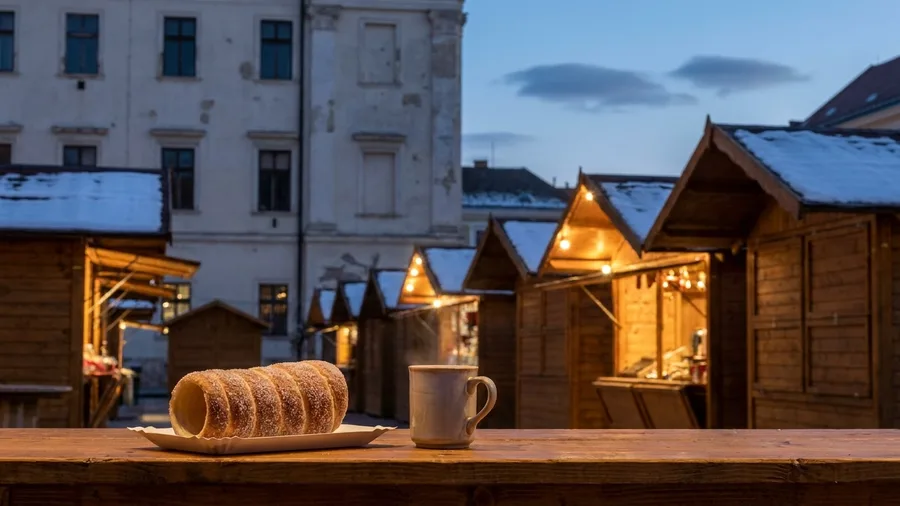
Where a German-speaking market asks for both cash and a spirit of adventure, this one asks for a wallet and very little else: two people can eat and drink on Széchenyi Square for around €25. Mulled wine runs about €3 a mug and a kürtőskalács, the chimney cake rolled in sugar, around €4, so a round of drinks and two pastries will not empty your pocket. Fifty euros covers that plus two sit-down lunches at €12-15 each, with change left over.
Dates are 1-23 December, with about 45 stalls on the square, and it works best as one night bolted onto a Budapest trip rather than a destination in its own right. The 2.5-hour train from Budapest makes it a cheap overnight add-on, and turning up at 17:00 gives you the evening. Most stalls are cash, so carry forints; the trade for that low cost is that the market is an extra leg, not the anchor of the trip.
9. Trenčín: thirty-five stalls under the castle
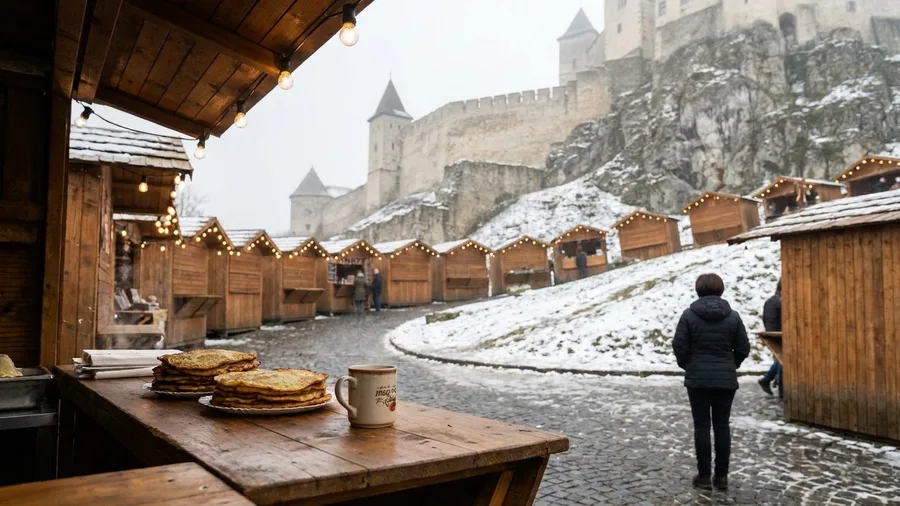
Thirty-five stalls, directly below the castle: this is the smallest of the quieter markets, and the one where you will hear Slovak around you rather than English. Dates run 1-22 December, and the whole thing sits on the slope under the castle walls, so you can walk it end to end in twenty minutes and then stand with a mug taking in the floodlit fortress above. Medovina, the honey mead, and lokše, the flat potato pancakes, are the things to buy, and almost every stall takes cash rather than a card.
The 1 hour 20 train from Bratislava gets you there, and a Tuesday or Wednesday evening at 18:00 is the best time to arrive, when the castle is lit and the square is quiet. This suits anyone already in Bratislava or Vienna with a spare evening, not a whole trip of its own; the trade is destination scale for a genuinely hushed market and Slovak rather than English spoken at the stalls, much like under-the-radar Midwest small towns.
Trenčín — At a Glance
☕ Mug
€3–4 + €3–5 deposit
🥞 Snack
Sausage or lokše €4–5
🍽️ Sit-down lunch
€12–15
🛏️ Bed for the night
€70–110 double
🕗 Closes nightly
20:00–21:00
Skip if
You want a full weekend: 35 stalls and 20 minutes end to end is the whole thing.
10. Sibiu: two squares and a Romanian Christmas
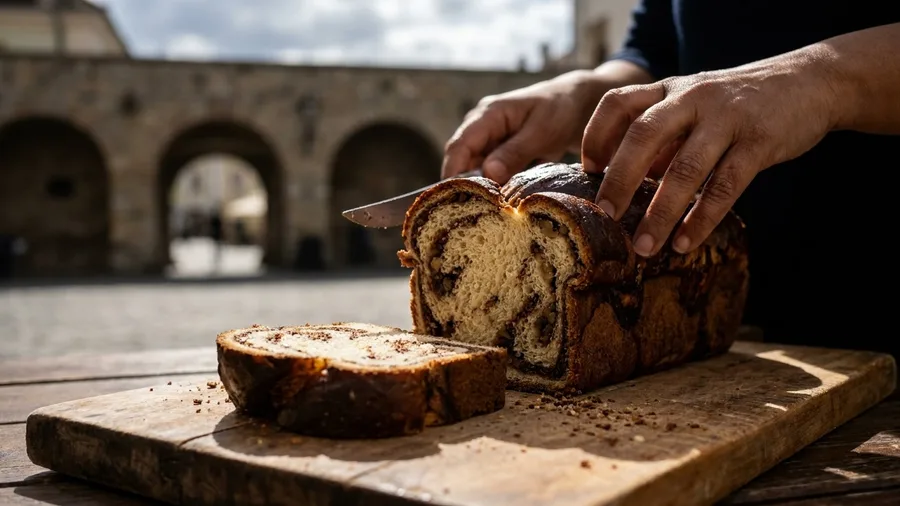
This is the one that asks for a real trip rather than a long weekend. It runs 24 November to 26 December, and the roughly 90 stalls are not in one place: they spill out of the Grand Square and continue into the Small Square, so you walk between them through a passage in the old walls, the lights of one square still behind you and the next opening up ahead.
Cozonac, the sweet braided bread, is sliced and sold by the loaf, and țuică, the plum brandy, is poured in small glasses from stands where the seller wants you to taste before you commit. Mulled wine is about 12 lei, around €2.40, and cards work at most stalls, so you are not hunting for an ATM on a cold night. Two people can eat and drink across both squares for less than a sit-down lunch back west.
Getting there is the catch. The night train from Budapest takes about eleven hours, and from the station it is a 20-minute walk into the centre, so the timetable alone rules out a weekend dash. Turn up at 17:00 on your first evening, when the light has gone and the squares are full but not yet packed, and the market reads as the town's own Christmas: families moving between the two squares, carols in Romanian, nothing built for a coach party. Spend the days in the Carpathian villages or across Transylvania and let this be the anchor. The splurge is the time, not the money: €70-110 a night in a central guesthouse is the cheap part, the eastern commitment is what you are buying.
Frequently Asked Questions
Is a smaller Christmas market actually worth it compared with Nuremberg or Strasbourg?
Yes, if you value time and space over scale. A 40-stall village like Kaysersberg takes 30 minutes to walk end to end, and a central guesthouse runs €70–110 a night against €180–250 in the big cities. You trade spectacle for a quieter evening with more local habit.
Which of these is open after Christmas?
Bruges is the only one on this list still running after 26 December, until 7 January. Bolzano runs to 6 January and Valkenburg to 5 January, so those are the other late options.
Do I need cash at these markets?
Bautzen, Kaysersberg, Pécs and Trenčín are still mostly cash. Bruges, Bolzano and Sibiu take cards at most stalls. Carry a €50 note broken into small coins for mugs and snacks either way.
What is the quietest time to visit?
Advent Monday to Wednesday, and weekday evenings before 19:00. Stalls close between 20:00 and 21:00 at all ten, so plan an early start rather than a late one.
How long do I need for each market?
Most take 90 minutes to two hours, including a drink and a snack. The smallest, Trenčín and Kaysersberg, can be walked in 30–40 minutes, while Bolzano and Sibiu, at about 90 stalls each, reward a whole evening.
Can I reach these markets by train?
All ten are walkable from a station, with the longest walk being 15–20 minutes from the platform. Sibiu is the outlier, with an 11-hour night train from Budapest, so it works as part of a longer trip east rather than a weekend.
The One Change I Would Make to This Itinerary
Do not rank these ten; match them. Bruges if you are travelling between Christmas and 7 January. Valkenburg for a family or a wet-weather day. Graz for a city weekend. Pécs if the budget is tightest. Sibiu if you can give December a longer trip east.
Two warnings worth repeating: Kaysersberg is Advent weekends only, and Bautzen, Kaysersberg, Pécs and Trencín run mostly on cash.
The Nuremberg and Strasbourg photos are not the only usable December. One smaller market, chosen for fit rather than fame, can carry a long weekend. Before you book any transport, check the Advent dates for the year you are travelling.
Check the Advent dates first
Open the calendar for the year you are travelling and confirm the run for Kaysersberg and Bautzen before you book a single train ticket.